

Legal deposit and bibliographic information
Information on the history of the library has been sourced from the book: 1861/2011: l’Italia unita e la sua Biblioteca, Firenze, Polistampa, 2011 (Catalogue of the exhibition held in Florence in 2011-2012)
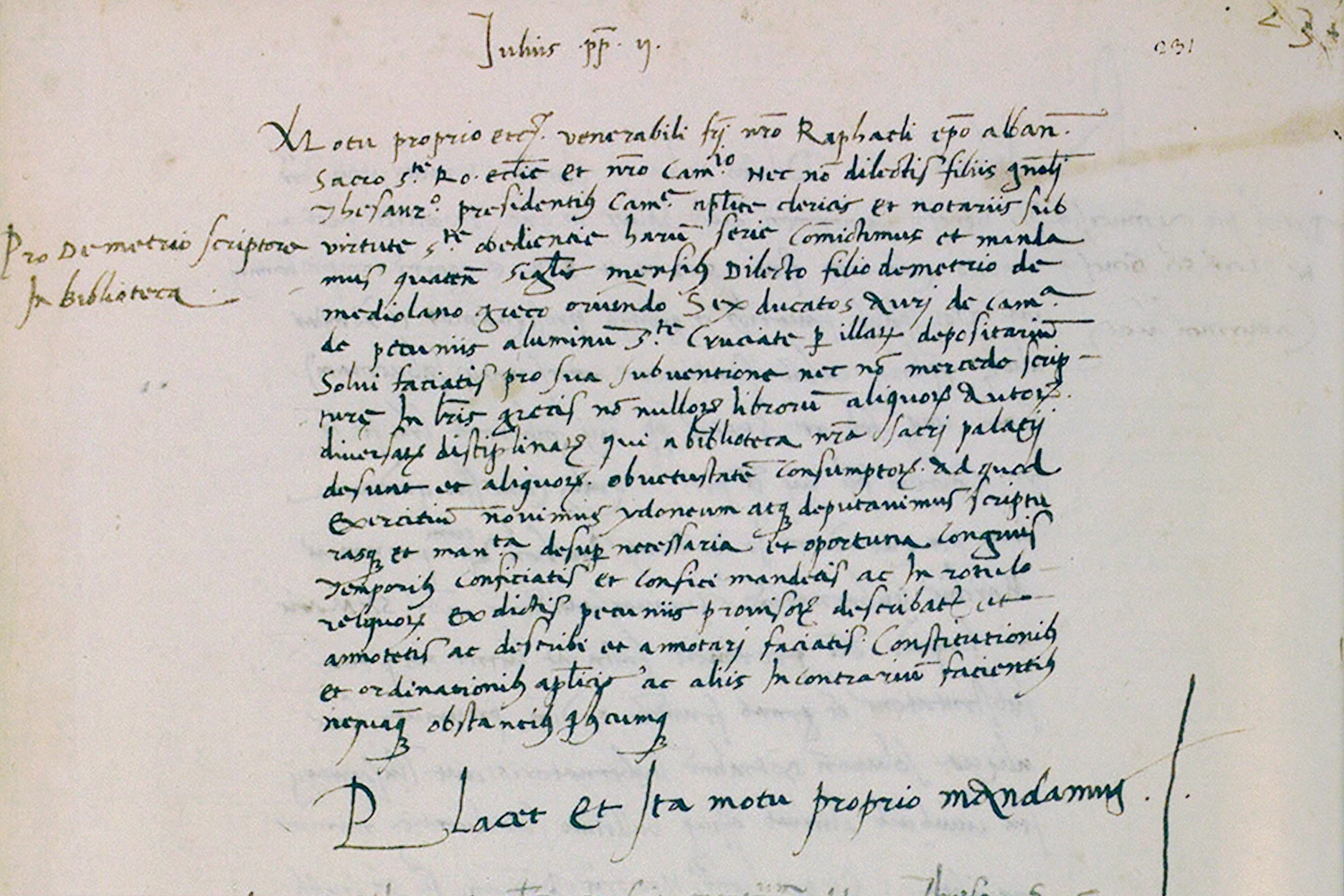
The national book archive: legal deposit
Legal deposit in Florence came about through the order passed by the Grand Duke Gian Gastone de’ Medici on 25 December 1736, which required the city’s typographers to provide a copy of everything they printed, thus ensuring the free development of the collections held in the Magliabechiana Library. In 1743, this obligation was extended to typographers throughout the Grand Duchy. Deposit was direct and unconditional, and the librarian personally issued a receipt to each printer on deposit.
“This dated back to the period in which the library was founded, and reflects an awareness of the practical duties that authors and publishers have not only in terms of public collections, which are a valuable source for all fields of study, but to a greater and more general extent towards national culture, which has been a driver for knowledge and art for generation after generation throughout the centuries” (GIUBILEO 1911).
In Italy, the legal deposit of publications was organically governed for the first time with the decree issued by Carlo Alberto on 26 March 1848. The preambles read: “after having stated that publishing will be free, albeit subject to strict laws, we have established the rules to be followed in our states for the exercising of said freedom”. In accordance with art. 7 of the publishing decree, this included the requirement for printers to consign “the first copy of any publication to the offices of the General Fiscal Attorney or the offices of the Fiscal Attorney at the court of the prefecture”. Furthermore, art. 8 required printers and typesetters, within 10 days from publication, “to consign one copy to the Court Archives and one to the Library of the university in the district of publication. Any printers or typesetters who consigned publications beyond the established period are subject to a fine of 50 lire. The above without prejudice to that established by the laws regarding the acquisition and conservation of literary property”. The result was twofold: the first function was that of jurisdictional control, and the second, provided for by art. 8, concerned the constitution of the national book archive through the gathering and conservation of publications.
The first post-unification reference to local legal deposit can be found in law no. 2337 of 1865 regarding literary property, which tied the protection of copyright to the presentation to the Provincial Prefecture of a maximum of three copies of each publication. Furthermore, the relative implementation ruling of 1867 established that within five days from legal deposit, “a copy of the declaration accompanied by certificate and a copy of the work presented should be sent by the Prefecture to the Ministry of Industry and Commerce, The other copy is to be handed on to the main local library, which will issue a receipt to be sent to the Ministry together with said declaration”.
The National Central Library of Florence became the depository for one copy of “all the works referred to in the current law on publishing, issued by the Crown Prosecutor, in accordance with the relative instructions of the Ministry of Justice, for which copyright is reserved”, in the wake of the issuing of the decree for the reorganisation of the Kingdom’s governmental libraries, no. 5368 of 1869, which was heavily influenced by the studies carried out by the dedicated Cibrario Commission.
All of this was further confirmed by the memorandum issued by the Minister of Justice on 30 June 1870, in accordance with which “Italian culture is to be celebrated in our library. In accordance with the law on publishing, it was decreed that a copy of every publication created in the Kingdom was to be deposited with the library. This meant that the library was permanently guaranteed the element most important for its existence: books that fully reflect modern Italian culture… and that provide uninterrupted documentation of national intellectual output”. (CHILOVI 1903).
Lastly, the 1885 Organic Regulations for Libraries clearly assigned the two National Libraries of Florence and Rome, which were granted the title of “Central”, with the task of gathering and conserving every work published in Italy and received through legal deposit. It was thus decided that the National Library of Florence draft the Bulletin of Italian publications received under legal deposit.
With the goal of conditioning politics, thought and awareness through preventative control exercised by Prefects over the books published in their provinces having been overcome, legal deposit evolved over time into a socially beneficial service, becoming an institution for the preservation of national cultural heritage with a view to fostering, safeguarding and spreading national culture through the issuing of the Bulletin, which documents and publicises national publishing. It is important to stress the extent to which the effectiveness of this tool is related to the quality of the service offered by the depository libraries. Attentive conservation and protection policies are the only way to ensure the rapid forming of full collections.
Bibliography
- Chilovi 1903
Desiderio Chilovi, L’archivio della letteratura italiana e la biblioteca nazionale centrale di Firenze, Firenze, Bemporad, 1903. - Giubileo 1911
Giubileo di Cultura, Firenze, Nerbini, 1911.
Updated as of December 2011
Bibliographic information before the “Bulletin”
In the first centuries of printing, “bibliography” referred to the activity of composing inventories of learning with the aim of creating a form of virtual library of vast sections of book production, as demonstrated by the monumental Bibliotheca universalis compiled by Conrad Gesner (GESNER 1545). The term bibliography was used as early as the Seventeenth century to refer to information regarding current production, given the need to update collections, but it was between the Eighteenth and Nineteenth centuries, with the production of sales catalogues, that more accessible sources of information began to emerge. Parisian booksellers refined the “technique of cataloguing and classifying books known as bibliography” (BALSAMO 1995). The analytical bibliography, describing antique books, thus differed from the general bibliography, whose aim was to provide general information tools documenting the editorial production of different areas of the country. Publishers in various European countries began to produce the first general bibliographies in periodicals. Once exception to this was France, whose “Bibliographie de la France”, from 1811 onwards, represented the “most subjectively informed example of a national bibliography as an act of government” (INNOCENTI – MALTESE 1988).
Attempts to produce a national bibliography in Italy ran parallel to the birth of the new unified state. Once again, publishers reported on the latest releases in periodicals (CRISTIANO 1991; MARTINUCCI 1994, nos. 436-458).
The first general Italian bibliographic periodical could be considered to be the “Bibliografia italiana. Ossia giornale generale di tutto quanto si stampa in Italia” (general publication of all printed material in Italy), published in Parma at the Grand Duchy Typography by Francesco Pastori from 1828 to 1829. A longer life was enjoyed by the “Bibliografia italiana” (SERRAI 1999), a monthly publication produced in Milan by Giacomo Stella from 1835 to 1846 and the first national catalogue of editions printed in Italy and those printed in Italian in other countries. Between 1844 and 1845, with the aim of setting up a national centre for bookselling in Livorno, Giuseppe Pomba created the “Bollettino bibliografico dell’Emporio librario” of recent or existing publications, initially twice weekly and then weekly. Then came the “Giornale generale della bibliografia italiana”, printed in Florence by Giacomo Molini from 1861 to 1865, a monthly publication inspired by the Bibliographie de la France.
However, the forbear of the “Bulletin of Italian publications received by legal deposit” is considered to be the almost twenty-year project of the “Bibliografia italiana” produced by the Associazione tipografico-libraria (DEL BONO 2001). The Unification of Italy paved the way for State intervention. 1863-1864 marked the first attempt at an up-to-date official bibliography with the “Annuario bibliografico italiano”, published by the Ministry of Public Education on the basis of the legal deposit copies sent by the various Public Prosecutors. The first issue read: “Two direct channels were available to the editors: the Royal Prosecutors, who, in accordance with legal deposit are obliged to report all works published, and the publishers (MINISTERO DELL’ISTRUZIONE PUBBLICA 1863). This was followed between 1867 and 1869, in the period in which Florence was capital, by the “Bibliografia d’Italia”, published monthly in Turin and Florence on the basis of an agreement between the Ministry and the publishers Bocca, Loescher and Münster. It was modelled on the “Bibliographie de France”, subdivided into two parts: bibliography and news. The bibliography included periodicals and foreign publications, and came complete with a general index and a systematic index with twenty classes. This initiative, which began in 1867, marked the moment in which the National Library of Florence began to play a central role: “a bibliography was published as a private initiative, ‘compiled on the basis of documents communicated to the Ministry of Public Education’, i.e., with the catalogue cards of the National Library of Florence” (INNOCENTI – MALTESE 1988). The initiative was only consolidated with the founding, in 1869 in Milan, of the Associazione Libraria Italiana, which as of January 1872 was known as the Associazione Tipografico-Libraria. It was based in Florence until 1875, and published the “Bibliografia Italiana” as a continuation of the “Bibliografia d’Italia”, reflected in the first issue characterised as year 4. This is understood to be the first true current Italian bibliography, responding to both the need to communicate library information and the need for official recognition of the publishing output of the new Italian state. From 1886 until at least 1903, the bibliographic part of the periodical ran parallel with the “Bulletin”.
Bibliography
- Balsamo 1995
Luigi Balsamo, La bibliografia, Milano, Sansoni, 1995 - Cristiano 1991
Flavia Cristiano, Riviste di bibliografia corrente nell’Ottocento italiano, «Nuovi annali della Scuola speciale per archivisti e bibliotecari», 5, 1991, p. 141-161. - Del Bono 2001
Gianna Del Bono, Per una storia della Bibliografia nazionale italiana. Desiderio Chilovi e i primi quindici anni di vita del “Bollettino” (Parte Prima), «Culture del testo e del documento», 2001, settembre-dicembre, p. 5-82. - Gesner 1545
Konrad Gesner, Bibliotheca universalis, Tiguri, Froschover, 1545. - Innocenti – Maltese 1988
Piero Innocenti – Diego Maltese, Cento anni dalla nascita di una bibliografia nazionale, in Bollettino delle pubblicazioni italiane ricevute per diritto di stampa. Scheda bibliografica nel centenario della fondazione, Firenze, presso la Biblioteca, 1988, p. 5-6. - Martinucci 1994
Andrea Martinucci, Guida alla bibliografia internazionale, Milano, Editrice Bibliografica, 1994. - Ministero dell’Istruzione Pubblica 1863
Ministero dell’Istituzione Pubblica (a cura), Annuario bibliografico italiano, Torino, Cerutti e Derossi, 1863-1864. - Serrai 1999
Alfredo Serrai, Storia della bibliografia, X, Roma, Bulzoni, 1999.
Updated as of December 2011
The Bulletin: the past to our present
The Bulletin of Italian publications received under legal deposit was born on 15 January 1886 on the basis of art. 62 of the 1885 Regulation for public libraries; the article appointed the National Library of Florence as responsible for periodically producing the bulletin, subdivided by subject.
The Bulletin was the brainchild of Desiderio Chilovi, who, ten years before its founding, had already come up with a practically definitive draft of the catalogue project, studying structure and purpose, above all the fundamental task of systematically cataloguing Italian publishing output, describing publications in a uniform and coherent manner. The Bulletin project also satisfied the need for cohesion and cultural development in an Italy that had only recently achieved political and administrative unity; only a national bibliography, an essential guide for anyone studying the life of a country, and part of a wider-ranging universal bibliography, could guarantee the effective circulation of biographic information, contributing to overcoming the isolation of Italian culture and favouring its inclusion in an international context.
It is not necessary to retrace here a situation that has already been widely described through highly documented efforts (Del Bono, 2002), if not to once again stress that the Bulletin was not created without a history. It was, one could say “born under a lucky star” (Chilovi, 1903); just two years later, in 1888, it was presented at the Paris Exposition and, when compared with similar publications “from 28 nations, not 28 cities” (Chilovi, 1903), it was considered as one of the best.
The Bulletin, the publication of which Chilovi assigned to his assistant Gaetano Cini, was initially published every two weeks in accordance with its nature of a current bibliography. It became a monthly publication in 1901 because, even for a Bulletin born under a lucky star, “sadder days were to come” (Chilovi, 1903) in the form of bitter clashes over bureaucratic obstinacy and the professional autonomy of the catalogue.
The issues of the Florentine publication contained a section dedicated to bibliographic descriptions and another containing various specific supplements, with Roman numerals to differentiate it from the more substantial bibliographic section. Each was completed with a title page and contents.
In celebration of the centenary of the founding of the Bulletin, the National Library published a volume on the catalogue describing the yearly issues, showing how the structure of the Florentine publication evolved over the years. The result was a detailed study presenting the Bulletin and proving fundamental for its consultation (Biblioteca Nazionale Centrale Firenze 1988). One characteristic of the Bulletin is of particular interest: for more or less the first forty years of publication, it carried a News section (included in the pages marked with Roman numerals) containing a series of articles on various topics of interest for scholars and the library staff.
These articles, which persisted for varying periods of time over the forty years during which the section was published, contained information on cataloguing and the collections held in the Kingdom’s libraries, news related to international debate and studies, reviews of the latest innovations in the library world, reports on the leading bibliographic and library science publications from both Italy and abroad, accounts of international conventions, and information on library regulations, competitions, staff events, promotions, transfers and deaths.
A cumulative index of all the news published between 1886 and 1925 resulted from the efforts of the aforementioned library.
An exploration of the index items illustrates the vitality of our past, providing snapshots of life and activity that serve as a bridge between the past and the present: the list of the thirty-six employees in active service at the National Central Library of Florence in 1886; the news of the visit by the “illustrious Ms. Giulia Sacconi nei Ricci”, assistant librarian of the Marucelliana in Florence in 1893 to libraries in Germany, Austria and Switzerland to study their organisation and working methods; the news of the practical librarian course held in 1894 by Mr. Puliti, the librarian at the Brera in Milan, for young people looking to begin a career as booksellers “to allow them to enrich the Italian book trade with all the practical and scientific knowledge that allows booksellers to assist scholars”; the announcement of readings in 1915 in the leading governmental libraries for wounded soldiers who had survived the front, an initiative that was met with immediate and extensive approval, and the obituaries that, with the exception of a few illustrious literary figures, were reserved exclusively for employees of Italian and some foreign libraries, contributing to fostering a solid sense of belonging.
Thus, also through this aspect of memory, the Bulletin served as an expression of the first seventy years of a long and continuing story, that of the National Bibliography, which has been carried forward since 1958 by the Italian National Bibliography.
Bibliography
- Del Bono 2002
Gianna Del Bono, La biblioteca professionale di Desiderio Chilovi. Bibliografia e biblioteconomia nella seconda metà dell’Ottocento, Manziana, Vecchiarelli, 2002. - Chilovi 1903
Desiderio Chilovi, L’archivio della letteratura italiana e la biblioteca nazionale centrale di Firenze, Firenze, Bemporad, 1903. - Biblioteca Nazionale Centrale Firenze 1988
Il Bollettino delle pubblicazioni italiane ricevute per diritto di stampa. Scheda bibliografica nel centenario della fondazione, Firenze, presso la Biblioteca, 1988.
Updated as of December 2011
