

The new site of the National Library
The construction of the current home of the National Central Library of Florence, located in Piazza dei Cavalleggeri, began in 1911 following a design by architect Cesare Bazzani. The building is one of the rare Italian examples of architecture specifically conceived for library purposes. Inaugurated in 1935, the structure was designed to house the institution’s rapidly growing monumental heritage, featuring an eclectic facade with distinctive turrets and grand reading rooms. Despite its architectural significance, the choice of the site adjacent to the Santa Croce complex proved tragic in 1966, when its proximity to the Arno River exposed the building and its treasures to the devastating flood.
Information on the history of the library has been sourced from the book: 1861/2011: l’Italia unita e la sua Biblioteca, Firenze, Polistampa, 2011 (Catalogue of the exhibition held in Florence in 2011-2012)
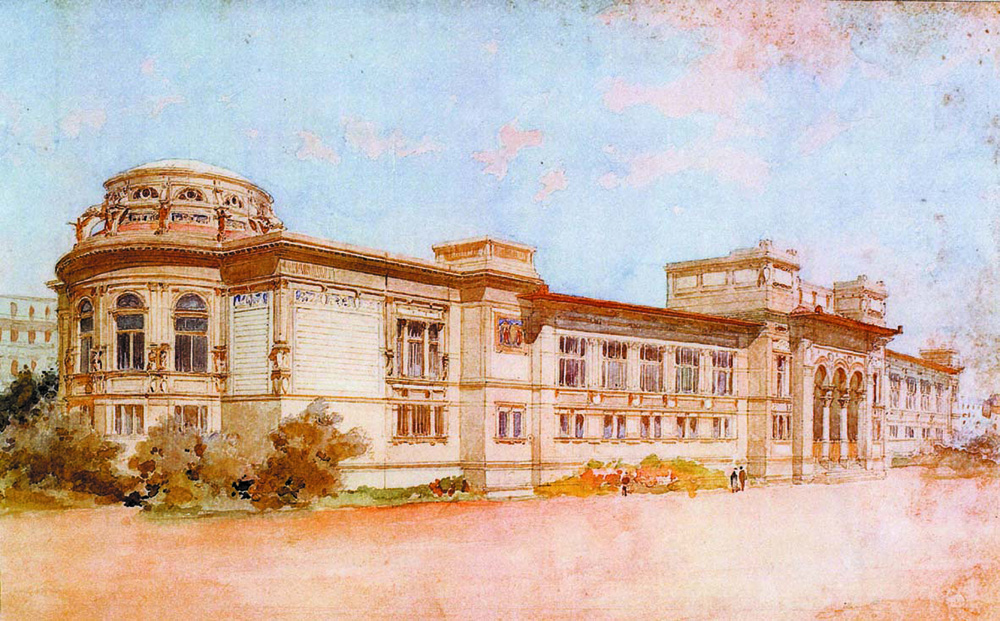
The plans, the competition, the choice of location, the spaces
As early as the end of the 1800s, the National Library in Florence, and its cataloguing, was considered to be in a sorry state. The fact that the library was divided between multiple buildings hindered uninterrupted and efficient services, and obstructed the convenient layout of both the furnishings and the books themselves, the number of which was growing day after day.
Merit for the identification of solutions to the problems faced by the library is to be attributed mainly to Desiderio Chilovi, a great librarian who was appointed director in 1885 and who recognised the real needs of Italian libraries, working and applying his own personal, modern and organised thinking to obtain permission for a brand-new building in what was the centre of Florence at the time, an area preparing, thanks to the city’s recovery plan, to embark on “… a new lease of life”.
The various proposals for the location of the new library submitted, one after the other, by the municipal authorities in line with the shifting context of the large-scale works taking place in the city at the end of the century, were promptly assessed by the librarian, together with the relative drawings and plans, but each one was quickly deemed to be impractical, either due to bureaucratic or administrative problems or to the unsuitability of the spaces themselves. In 1900, following 15 years of fruitless attempts, the central government authorities and the municipal authorities finally agreed on a definitive location in the area between Corso dei Tintori and the second cloister of the Basilica of Santa Croce, an annex of the convent of the same name. The agreement stipulated between the Municipality, the Government and the Florence Cassa di Risparmio allocated the sums necessary for completion of the works, which were initially made available by the Cassa Centrale di Risparmi e Depositi with a low-rate loan of 2,900,000 lire including land expropriation. The portion of this sum covered by the Municipality was set at 300,000 lire, in addition to part of the land donated.
The call for tender was published on 31 December 1902. The commission legally nominated on 29 September 1903 was composed of the President Camillo Boito, Gaetano Koch and Ernesto Basile, appointed by the Government; Riccardo Mazzanti representing the Municipality; experts in the library sector Giuseppe Salvo, the director of the Library of Palermo, and Desiderio Chilovi, who was substituted on his death on 7 June 1905 by Salomone Morpurgo; and Tito Azzolini, elected by the participants of the call for tender.
From the forty architects taking part in the first round of the competition, and the 12 chosen for the second round (Bazzani, Piacentini, “Delfo”, Sabatini, “Sidera”, Fantappiè, Bovio, Rivas, “Nemo”, “Aemilia”, Garroni and Fondelli), which took place between 1904 and 1906, the final winner was Cesare Bazzani, a young architect and engineer from Rome (DBI, v.7); (CESARE BAZZANI 2001).
The greatest task of the competing figures was not so much that of finding suitable solutions that could be adapted to the chosen space, considering that, in any case, as someone said, “… solving the problem of constructing a building for the books in the space that surrounds the second cloister of Santa Croce is more or less like squaring the circle” but rather “that of identifying an architectural solution that would allow the large building to be a worthy accompaniment to the stunning example of fifteenth-century art that is the square cloister of Santa Croce…”, which would then border “… the future Via Magliabechi, the main cloister, and the southern side of the church.” (GIUBILEO 1911).
The proposals varied widely in architectural terms, some with 15th-century references and others with more modern traits, in an attempt to combine old and new styles. Of the proposed solutions, the project from Piacentini was characterised by a triple entrance from Piazza dei Cavalleggeri, with a style based on 14th and 15th-century Florentine architecture interpreted with a personal and modern touch. The architect proposed a library that, with its grand architecture, could be seen as more appropriate for highly scientific scholars.
On the contrary, the engineer Francesco Paolo Rivas proposed a building with a long facade bordering Corso dei Tintori, which sought to externally express the role of the library and which included the access point, with as regular a plan as possible and rich with opulent decorations, coats of arms of the city positioned over all the windows and statues of important Florentine figures positioned in between.
The project presented by the architect Enrico Dante Fantappiè drew inspiration from Fifteenth-century Florentine palaces. The two-floor building, with a raised ground floor and large windows, had its main facade bordering Corso dei Tintori, and was divided between a principal section leading towards Piazza dei Cavalleggeri, and two lateral pavilions to the rear, with friezes, decorations composed of bas-relief in imitation Della Robbia pottery and the coats of arms of the major Italian cities. The secondary facade ran along the new Via Magliabechi, with the same architectural lines as the main facade, but devoid of decoration.
The “Sidera” project provided for a four-floor building with the main facade overlooking Corso dei Tintori, running symmetrically with Piazza dei Cavalleggeri, onto which the generous entrance opened. The designer claimed to have drawn inspiration from “freely interpreted Florentine art traditions of the most characteristic period” (EDIFICIO 1986).
The architect Ezio Garroni presented a project composed of large constructions featuring recesses and protrusions, with numerous windows and decorations limited exclusively to the central section, which housed the entrance, positioned in line with and facing onto Piazza dei Cavalleggeri.
The solution proposed by Bazzani, extensively illustrated and praised by the-then director Salomone Morpurgo during his speech held on the occasion of the laying of the cornerstone on 8 May 1911, provided for the main axis of the new building to cross the “grand vestibule, or point of distribution”, corresponding to the centre of Piazza dei Cavalleggeri, onto which the entrance portico was to face, providing access to the atrium and then to all the library services. “The founding criterion of the construction and the internal layout”, continued Morpurgo in his speech, “was to place all of the bodies related to the public use of the institute and to the day-to-day operations of the same on the significantly raised ground floor of the avant-corps” (GIUBILEO 1911).
These initial comments gave indication of the aims of Bazzani, but further on, attention was also focused on the areas appointed for the representative duties of the library, i.e., the “Library museums” and the “Reception areas”, which could be accessed “via the two staircases flanking the first vestibule”, but principally “from Via Magliabechi, having crossed the monumental rotunda, which will house, with its Dantesque and Galilean galleries, a spacious hall for meetings and conferences. From here, in a series of increasingly grand halls and stairways, visitors will climb to the aforementioned galleys and to the halls exhibiting the most prestigious items: illuminated manuscripts, autographs, incunables, rare editions, engravings, etc…”.
Bazzani’s project thus unequivocally combined areas and functions with innovative design and technological solutions. This combination of space and function was unfortunately and suddenly undone with the 1966 flood, which devastated the building. In the wake of the ministerial ban on holding library collections in basement areas, the Reading Room, for example, was turned into storage space for the newspaper collections, until the transfer in 1990 of the Newspaper Library to the Forte di Belvedere, which allowed the directorate to reopen the monumental Reading Room and to once again set up many of the functions in their relative areas as intended by the architect.
The spaces created for representative functions, on the contrary, have managed to always maintain their appearance and purpose. Indeed, although the Galilean gallery has never actually housed the works of Galileo Galilei and his school, the Dantesque gallery and the other halls on the first floor have served their purpose as “Library museums” and spaces for meetings and conference with dignity.
One example of the functional nature of the exhibition spaces was the exhibition organised as part of the series of events dedicated to Lorenzo the Magnificent (LORENZO DOPO LORENZO 1992) which, granting access from the entrance in Via Magliabechi and having the itinerary lead from the staircase to the hall of honour, and from there to the Dantesque gallery, allowed the exhibition to be enjoyed to the full while permitting the everyday activities of the library to continue uninterrupted.
The idea of restoring full use of this wing of the building for exhibitions and receptions was considered at length by the-then directorate of the library, which, at the end of 2011, was able to return these spaces to their use as intended by the architect Bazzani, as was the case with the aforementioned restoration works of1990.
Bibliography
- Cesare Bazzani 1988
Cesare Bazzani: un accademico d’Italia, a cura di Michele Giorgini, Valter Tocchi, Perugia,Electa,
1988. - Cesare Bazzani 2001
Cesare Bazzani e la Biblioteca nazionale centrale di Firenze (1873-1939): atti delle giornate di studio, Firenze, Tribuna Dantesca della Biblioteca nazionale centrale, 20-21 novembre 1997: nuovi studi e documenti, a cura di Ferruccio Canali e Virgilio Galati, Firenze, BT, 2001. - Edificio 1986
L’Edificio della Biblioteca nazionale centrale di Firenze, Firenze, Forte di Belvedere, ottobre –novembre 1986, Firenze, Karta, 1986. - Giubileo 1911
Giubileo di Cultura, Firenze, Nerbini, 1911. - Lorenzo dopo Lorenzo, 1992
Lorenzo dopo Lorenzo: la fortuna storica di Lorenzo il Magnifico, Firenze, Biblioteca nazionale, 4 maggio-30 giugno 1992, a cura di Paola Pirolo, [Cinisello Balsamo], Silvana, [1992] .
The furnishings
Twenty-five years, an extremely long period of time over which “works slowly proceeded with unsuitable means”, marked a stark contrast in linguistic expression between the declarations contained in the report that accompanied the project submitted for the National Central Library of Florence call for tender (1904 – 1906) and its indoor furnishings, which were mostly completed between 1934 and 1940 (EDIFICIO 1986). The aim of “reflecting the atmosphere” expressed by Cesare Bazzani and demonstrated above all by the aim to innovatively link the external image of the building to examples of grand Florentine Renaissance architecture was suitably accompanied by the decorative creativity of the “elaborate fantasy” applied to the interior walls, to such an extent as to guarantee “visual continuity” between the various parts of the building (CESARE BAZZANI 2001). The rare drawings by Bazzani dating back to 1906 show furnishing that marks a clear reference to “tradition”, modulated by a bold stylistic freedom that varied, reinvented and corrupted tradition itself, often teetering on the edge of excess, but above all demonstrating his most direct references, first and foremost the self-restrained composure of his beloved maestro Guglielmo Calderini. The proposal of new furnishings five years on from the laying of the cornerstone called for a change in direction that made it increasingly difficult for Bazzani to draw on the forms conceived before the Great War, in a period in which Italian architecture had moved in a new direction. In 1931, his designs were included in the abominable “Table of horrors” that Piero Maria Badi presented to Benito Mussolini, calling on architecture to make a shift towards contemporary forms of expression. The obligation to embrace dutiful and at that point unavoidable Rationalist developments could no longer be put off, although later projects revealed a poor assimilation of new trends, where for every nine parts of Roman architecture, Bazzani reluctantly added one part of adopted European Rationalism. The study of the furnishings for the National Library was assigned by Bazzani to Italo Mancini, his young, loyal external collaborator, who was highly attentive to the innovative furnishing proposals that filled the pages of the Architecture and Decorative Arts magazine: in 1929 a panorama of the functional organisation and the relative equipment in the most important public libraries of the Western world, the Soviet Union included (ARCHITETTURA E ARTI DECORATIVE 1929), and in 1930 a detailed report on “Modern library items and equipment” (ARCHITETTURA E ARTI DECORATIVE 1930), which featured a presentation of the most innovative solutions, experimented by Mancini himself in the call for tender for the new offices of the Governorate of Rome (1928) and for the Palazzo dell’Automobile (1929). Although Cesare Bazzani had oversight, the young architect was supported in his proposals and choices by the attentive and skilled guidance of Domenico Fava, the-then director of the National Library. The Milanese company Lips-Vago, with its light alloys, resolved the organisational and functional problems faced by the furnishings, first and foremost with the design for the one-hundred metal draw units specifically constructed with a roller shutter and wheels for the transportation of books from Piazza de’ Giudici to the new premises, as well as the installation in the library’s storage rooms of metal shelving units, with an initial extension of 40 km, a structural element that covered five floors, and the four drawer units for the subject indexing system acquired in 1940. The latter were positioned in the catalogue hall, which, more than any other area, demonstrates its late design and its embracing of Rationalist style: the light that enters from the central velarium highlights the dynamic spiral staircase that connects the two galleries in a scenographic manner, accentuated by four pillars partially clad in polished stainless steel. In the centre, double-pitched tables set on tubular metal legs with shatter-proof glass served as supports for the catalogue books of the antique collections, while a further four level tables served for consultation of the card catalogue. This hall shared clear aspects with the furnishing solutions that Italo Mancini had previously proposed in 1932 in the projects for the call for tender for the interiors of the Casa dell’Aviatore. The furnishings in the Consultation hall on the first floor, instead, were of a more representative nature, in line with the importance, rigour and purpose of the space. The series of reading rooms are divided by monumental doors in walnut, which contrast the transparency of the divisions between the rooms on the ground floor and along the various connecting corridors. Continuity between the consultation halls is provided through the connecting galleries. The essence of the old Eighteenth-century bookshelves is maintained through the double-level bookcases, to which a new access system has been added: the narrow spiral staircases positioned at the corners of the rooms have been gradually substituted with more comfortable straight wooden staircases that are hidden by shelving, thus providing a clear view of the book-lined walls. Large walnut reading tables of simple design are provided, with each place furnished with a light source in milk glass fitted to a bronze arm, produced by the Milanese Fontana Arte. The original, enveloping seats offer a modern interpretation of the ancient Greek klismos, an armless chair with a curved backrest that here provides the reader with a sense of privacy. The extraordinary attention to detail of Italo Mancini has resulted in a legacy of elegant furnishings, such as the simple and functional coat racks and umbrella stands, and even more sophisticated fittings such as the doorhandles and the handles on the cupboard doors positioned at the base of the bookshelves, which have been designed with a focus on function (MINISTERO DELL’EDUCAZIONE NAZIONALE 1942). In October 1935, on the occasion of the inauguration of the building, an exhibition was held in the Dantesque gallery of parchment books from the 15th century, while the adjacent halls and the Galilean gallery housed a grand exhibition of the library’s Fifteenth-century illustrated books. For the occasion, three different types of display case – which continue to be put to good use – were designed, each in line with the space in which they were destined to be positioned: two-level linear display cases, made in walnut veneer and glass, were set between the columns in the two galleries, while a circular construction – again in walnut and glass – was positioned in the centre, crowned with an alabaster lamp, reflecting the perfection of the Renaissance temple of knowledge. These were followed by extremely elegant closed display cases, again by Lips-Vago, set on long legs in anticorodal aluminium and encased in curved glass. The design of the various light fittings reflected the modern innovations in art seen in at the end of the 1920s, with the production of Murano glass from Venini, designed by the sculptor Napoleone Martinuzzi. The connecting corridors, the monumental staircases and the reading and distribution halls were furnished with lighting elements made of evenly corrugated glass paste in a range of formats that, assembled together, created a series of shapes. For the management offices, Venini proposed extremely elegant wall lights, which remain to this day, composed of amber-coloured or opaque glass cups positioned on either metal or wooden brackets covered in corrugated glass elements.
Bibliography
- Architettura e arti decorative 1929
Architettura e arti decorative,VIII, fasc. II, 1929. - Architettura e arti decorative 1930
Architettura e arti decorative, IX , fasc.VIII,1930. - Cesare Bazzani 2001
Cesare Bazzani e la Biblioteca nazionale centrale di Firenze (1873-1939): atti delle giornate di studio, Firenze, Tribuna Dantesca della Biblioteca nazionale centrale, 20-21 novembre 1997: nuovi studi e documenti, a cura di Ferruccio Canali e Virgilio Galati, Firenze, BT, 2001. - Edificio 1986
L’Edificio della Biblioteca nazionale centrale di Firenze, Firenze, Forte di Belvedere, ottobre –novembre 1986, Firenze, Karta, 1986. - Ministero dell’Educazione Nazionale 1942
Ministero dell’Educazione Nazionale, Le Biblioteche d’Italia dal 1932 al 1940, Roma, F.lli Palombi, 1942.
The move and the inauguration: The paper by Domenico Fava
In September 1938, Domenico Fava (DBI v. 45), the director of the BncF at the time of the move from the library’s previous location in the Uffizi, returned, in his large-scale and comprehensive work on the Florentine National Library (FAVA 1939), to the question of movement, referencing the preparatory operations that provided an opportunity for a general inspection of all the collections of manuscripts and printed materials.
This examination of the collections proved essential, considering the condition of the collections after a period of fifty years in the old spaces of the Uffizi, with the rapid increase in the number of items and the ever-greater lack of room. This analytical study formed the most important part of the report that Fava submitted to the Italian Ministry of Education in January 1936 (FAVA 1936). Work on the new premises of the library continued, in the midst of obstacles of all kinds, including – naturally – the First World War, and more than twenty years separated the laying of the cornerstone (1911) and completion of the project (FAVA 1935/2). Fava, who was appointed director in July 1933, had to wait until July 1935 to begin the task of moving the books which, due to the modern nature of the means employed and thanks to careful planning, saw the transfer of a large-scale library setting an example of rapidity and precision. It took 54 days to move from the old site to the new premises, and at the end of June 1935, more than 800 thousand books and two-and-a-half million booklets were already accessible. However, what struck both specialists and the public the most was the simultaneous organisation of the collections in the library’s storage areas, with the result that on completion of transportation, the collections were fully organised and ready to be accessed. Due to their lightness, the specially made aluminium trolleys, designed by Fava himself for the move, proved to be an ideal response to ensuring that transportation operations were rapid, orderly and secure.
A detailed study of the method of organising the items in the new location was also carried out. Before moving operations began, all of the disorderly and muddled collections were brought together and put into order, after which attention was focused on the various sections, which in the old premises were scattered and disorganised, and that needed to be centralised in the new library for historical and operational reasons. This preliminary study served to create a logical reordering of the library furnishings, lending the library its systematic and unified nature. Thus was the situation for the library’s collections.
The problems related to services were another matter. Attention needed to be paid to all the requirements that, due to the condition of the spaces, were poorly met in the previous locations. Examples include the creation of the generous consultation halls, which brought together all the sciences, with more than 20 thousand volumes available to readers and with an increase in the number of places from 16 to 68. New aspects included the periodicals hall, as well as the Dantesque and Galilean galleries, which were destined to house library exhibitions. The former was extremely modern in layout, with only a handful of other libraries anywhere in the world offering anything similar, while the galleries, which were dedicated exclusively to Italian Fifteenth-century illustrated books and artistic bindings, owed their importance and beauty to the unmatched quality of the materials displayed, which were some of the most prestigious of their kind (FAVA 1936). By October, the new library was fully organised, coordinated and ready for operations to recommence. The inauguration presented a spacious general reading room with 136 places, as well as two smaller annexes, one for women users and the other for degree students, offering another 38 places; a public consultation area in the two passageways leading to the reading room and the catalogue hall for quick and independent research; an immense catalogue hall with a new index system, introduced by Fava himself as an innovative library solution; an essay department, which granted the general public access to all forms of research materials; brightly lit and comfortable rooms for the reading of manuscripts on the upper floor; and exhibitions of great interest for studying the history of books, set up in dedicated areas. All this was evidence of extensive understanding of the needs of the public and of the firmly held intention of rendering the library agile, balanced and significantly efficient in its operations (FAVA 1937/1). Once the setting up of the new premises was complete, the National Library reopened on 30 October 1935 with a grand inaugural ceremony, rendered even more important by the presence of His Majesty the King.
For the occasion, an exhibition of Fifteenth-century printed parchment books from Italian library collections was organised, accompanied by a catalogue (FAVA 1935)
Bibliography
- Fava 1935
Domenico Fava, I libri membranacei a stampa del secolo XV esistenti nelle biblioteche pubbliche italiane, Firenze, Alinari, 1935. - Fava 1935¹
Domenico Fava, Due biblioteche auliche nella Nazionale centrale di Firenze, «Accademie e biblioteche d’Italia», 9, 1935, pp. 448-474. - Fava 1935²
Domenico Fava, La Biblioteca nazionale centrale di Firenze dalla vecchia alla nuova sede, «Accademie e biblioteche d’Italia», 1935, n. 3-4, p. 419-447. - Fava 1935³
Domenico Fava, La Biblioteca nazionale centrale di Firenze dalla vecchia alla nuova sede, in Per l’inaugurazione della nuova Biblioteca nazionale centrale di Firenze, Roma, Biblioteca d’arte editrice, 1935, pp. 1-29. - Fava 1936
Domenico Fava, I libri italiani a stampa del secolo XV con figure della Biblioteca nazionale centrale di Firenze, con un’appendice di legature, Milano, U. Hoepli, 1936. - Fava 1937¹
Domenico Fava, Il trasporto e la sistemazione della Biblioteca nazionale di Firenze nella nuova sede: luglio-ottobre 1935. Relazione a S. E. il Ministro della educazione nazionale del dott. Domenico Fava. Firenze, Tip. Il Cenacolo, 1936; 2. edizione, Firenze, 1937. - Fava 1937²
Domenico Fava, La nuova sede della Biblioteca nazionale centrale di Firenze e la sua sistemazione, «Zentralblatt für Bibliothekswesen», Jahrg. 54, 1937, pp. 178-190. - Fava 1937³
Domenico Fava, Libri membranacei del Quattrocento, esistenti in Italia, «Gutenberg-Jahrbuch», 1937, pp. 55-78. - Fava 1939
Domenico Fava, La Biblioteca nazionale centrale di Firenze e le sue insigni
Raccolte, Milano, Hoepli, 1939.
The Basilica and the Library
Before its urban transformation in the Eighteenth and Nineteenth centuries, the heart of the Santa Croce district was the Franciscan church of the Friars Minor Conventual, around which a large number of textile-processing businesses had developed.
With the transfer of the capital to Florence, which was established by Italian Law no. 2032 of 11 December 1964, the Convent of Santa Croce was chosen as the home for a section of the Ministry of Finance, the General Directorate of the Public Dept, in accordance with Italian Law no. 384 of 22 December 1861, which allowed the Government to occupy convents for civil service purposes. Provided with a new entrance and created from the friars’ cells, joined in pairs, the offices of the Directorate were set up in the east wing and in a part of the wing to the south of the “main cloister”, more commonly – and improperly – known as the Brunelleschi cloister, which was completed in 1453. For the Friars Minor Conventual, who had been residing in Santa Croce since 1228, a smaller convent was constructed behind the church, complete with a new dining hall, a kitchen and a number of cells.
The wing of the cloister leading towards Corso dei Tintori, had for some time been separated from the convent complex, as in 1572, part – “…Accommodation and the old infirmary…” – was transferred to the Grand Duke Cosimo de’ Medici, who transformed it into barracks for the Cavalleggeri – light cavalrymen – (hence the name Piazza dei Cavalleggeri), while another part went to the Royal Manufactory Bureau for a cavalry unit known as the “Dragoni”. The areas surrounding the Cloister represented the most important part of the convent complex ever since – with the construction of the new church – the Franciscans increased in number and the complex was extended towards the Arno.
The suppression of religious orders, corporations and congregations established by Royal Legislative Decree no. 3036 of 7 July 1866 (executing Law no. 2987 of 28 June 1866), followed by Law 3848 of 15 August 1867 concerning the liquidation of ecclesiastical property continued to guarantee the possibility of allocating the areas of the old convent for activities not related to religious life. In practice, the holy properties open for worship, such as the Church of Santa Croce, which were recognised as necessary for the spiritual needs of the population, were passed to the Worship Fund, which answered to the Ministry of Justice and Worship (the Ministry of the Interior from 1932 onwards), but the convents were handed over to State Property administration, which handled their disposal, in accordance with a law passed in 1962, or their devolution, with regular payment to the Worship Fund. The historical and artistic items owned by the convents were devolved to museums and public libraries within the province in accordance with Decree 3036. The documentation regarding the appropriated items was later transferred, between 1877 and 1878, to the State Archive of Florence, the Departmental Directorate of State Property and Taxes of Florence, Religious organisations suppressed by the Italian Government.
Similar measures were applied in the wake of the Napoleonic suppressions of 1808, with a decree dated 29 April, and of 1810, with a decree dated 13 September: these measures effectively subtracted the church and the convent from the Franciscans, but they were later overturned in the wake of the restoration of the House of Lorraine in 1814. All of the property of the Convent had, like the archive, been appropriated as part of the Archive of Suppressed Religious Organisations – now in the State Archives – as was the case for the extensive and renowned library, which had been reconstructed by the Friars Minor Conventual following the orders issued, by no coincidence, in 1766 by Pietro Leopoldo of Lorraine for its almost complete transfer to the Mediceo Laurenziana library.
In particular, in the wake of the decrees from 1808 and 1810, the Laurenziana additionally received almost 20 codices from Santa Croce, while the remaining collection of 122 codices and 39 printed books were transferred to the Magliabechiana Library on 17 March 1812. As far as the Medicea Laurenziana library is concerned, the collection remains divided between the Latin and Italian Codex collection (previously Santa Croce, merged in 1767) and the Suppressed Convents collection, while for the National Central Library of Florence, previously the Magliabechiana Library, the codices all went to the Suppressed Convents collection.
In accordance with article 20 of Decree no. 3036, municipalities could be granted use of property belonging to religious orders, on submission of a request for use for public benefit. In 1868, by virtue of these measures, the Municipality of Florence obtained access to the convent of Santa Croce by public deed dated 29 April, and it became the legal owner, “…together with all buildings and annexes”, in 1871. The convents transferred to the municipalities were almost always parcelled and therefore assigned to a range of different entities. In the convent of Santa Croce, the areas on the side that separated the first cloister from the so-called “main cloister” were home, from 1878, to the Professional School of Decorative and Industrial Arts, later to become the Florence Institute of Art (at the time the School of Engraving). The school occupied a number of areas on both the ground and first floors, with the latter having, at one time, served as the home of the historic library of the Friars Minor Conventual. The areas previously occupied by the offices of the Ministry of Finance, before it was transferred to Rome, were assigned to the Territorial Engineering Directorate, which used them to house an infantry battalion and a number of Military Administration offices.
On 2 May, 1900, a commission assessed the precarious conditions of the National Central Library of Florence, which by then had grown to occupy three adjoining buildings to the rear of the Uffizzi, between Piazza del Grano and Via dei Castellani: the rooms shored up on the orders of the Civil Engineering department, the lack of space and the threats posed to the building by the sheer weight of the books. The solution, which could no longer be postponed, was provided by an agreement drawn up between the State, the Municipality and the Cassa di Risparmio on 4 February 1902, approved with Law no. 337 passed on 21 July 1902, which established the construction of a new library in Corso dei Tintori. The agreement also provided for the allocation by the Municipality of a portion of the ex-Franciscan convent of Santa Croce, specifically the part corresponding to the “main cloister”, where the offices being used by the Territorial Engineering Directorate were located, with the exception of the north wing, which was occupied by the School of Decorative and Industrial Arts. In addition, this provided a way to offer an immediate location for part of the collections of the National Central Library, transferring them to the areas acquired in the ex-convent. The fact that the Cloister was adjacent to the site of the future library also made it easier to move the collections once building had been completed.
In effect, as can be seen from documentation, the spaces in the ex-Franciscan convent became “temporary storage” for the first batch of library materials transferred from the old site of the National Central Library. The placing of all the political newspapers published since 1870 in the rooms on the ground floor of the Cloister was completed in 1911, just as construction of the current site began. Additionally, the Ministry of Education had, in 1909, managed to obtain use of the areas occupied at the time by the School of Decorative Arts, which was due to move to Porta Romana, an operation completed in 1923. Just a few years later, in 1926, operations began for the transfer to Santa Croce of a portion of the books held at Palazzo dei Giudici, which was home to a large part of the Library’s collections, but which was at that point on the brink of being overwhelmed. In 1930, following the inauguration of the Dantesque Gallery, the first section of the Library to be completed but clearly more monumental than functional, a provisional hall was set up for the reading of political newspapers and periodicals.
The Nineteen-thirties saw not one but two new “births”: in 1933, the Friars Minor Conventual were reinstated, with their “province” being granted recognition as a religious institution with its main headquarters in Santa Croce, and the church being elevated in status to Minor Basilica, and in 1935, the new site of the National Central Library of Florence was inaugurated.
The ancient fifteenth-century architectural lines of the “main cloister”, currently governed by the Ministry of Cultural Heritage and Activities and home to a number of the Institutes important library collections, were returned to light after having been hidden by the modifications made in the 19th century to adapt its spaces to its new institutional role. Over the course of that century, the spaces were used for purposes that differed greatly from those for which they had been conceived, to the extent that they were subject to radical modifications that had stripped the building of its identity.
A number of photographs by Alinari show the architectural state of the Cloister – thirty-one metres wide by thirty-eight – in the Nineteen-twenties: the lower portico was more or less as it is today, with semicircular arches and rib vaults supported by stone columns that recall the structure of the Ospedale degli Innocenti in Piazza della SS. Annunziata; on the contrary, the upper section showed the structure of a loggia, but was walled off and fitted with large shuttered windows that clashed with the rest of the setting. The later restoration of the upper portico highlighted the stone columns, which were freed of the walling, as well as the wooden roof and terracotta cladding. The medallions that can be seen between the arches show the coats of arms of the family of Tommaso Spinelli, the rich banker who, in worship of San Francesco, financed the construction of the Cloister and whose coat of arms can be found over the door that leads into the entrance hall.
The restoration of the Cloister also allowed for the safeguarding of a reproduction of the Arte di Calimala, the guild of cloth finishers and merchants, on the northern wall of the upper loggia, facing the Church, which depicts an eagle grasping a bolt of cloth. In 1427, the guild, which owned a part of the Convent, used the inheritance left to it by a layman, a butcher by the name of Michele di Guardino, to cover the expenses for the expansion and maintenance of the extensive library of the Friars Minor Conventual, which had found a suitable home on the first floor of the wing of the convent that lies between the two cloisters, extending towards the church. The coat of arms of this benevolent figure, depicting a rearing bull, can still be seen on the wall of the upper floor of the portico, alongside that of the guild.
Faint and modest fragments of frescoes can be made out on the wall of the upper loggia of the cloister, which the inauspicious transformations of the 1800s were unable to “suppress”, and that evoke a social status still linked to the working of textiles and considered more humble than that of Florence the Capital, as well as far removed from the political context that, in the period in which Vasco Pratolini set his novel The Naked Streets, once again forcefully changed the identity of the district.
Bibliography and archive references
- Biagianti Ivo
Biagianti Ivo, La soppressione dei conventi nell’età napoleonica, in La Toscana nell’età rivoluzionaria e napoleonica, a cura di Ivan Tognarini, Napoli, Edizioni scientifiche italiane, 1985. - Branca – Caputo
Branca Mirella – Caputo Annarita, Decoratori per una città d’industrie artistiche all’ombra di Santa Croce (1880-1919), in Storia dell’Istituto d’arte di Firenze (1869-1989), a cura di Vittorio Cappelli e Simonetta Soldani, Firenze, L. S. Olschki, 1994. - Cappelli Vittorio
Cappelli Vittorio, Da Santa Croce a Porta Romana. Le molte ambizioni di un istituto modello, 1919-1939 in Storia dell’Istituto d’arte di Firenze, 1869-1989, a cura di Vittorio Cappelli, Simonetta Soldani, Firenze, L. S. Olschki, 1994. - Convenzione fra il Comune di Firenze e la Cassa centrale di Risparmi e Depositi di Firenze e l’Amministrazione dello Stato per la costruzione di un edificio ad uso della Biblioteca Nazionale Centrale di Firenze, 4 febbraio 1902, cc. 1-2, Biblioteca Nazionale Centrale di Firenze, Archivio Storico della Biblioteca Nazionale Centrale di Firenze, n. 634, fasc. 14.
- Ex Convento di Santa Croce in Firenze. Demanio nazionale e Comune di Firenze, 31 maggio 1907, Biblioteca del Convento di Santa Croce Firenze, Archivio storico della Provincia Toscana delle Ss. Stimmate dei Frati Minori Conventuali, n. 2, fasc. 1, s/6.
- Fantozzi Micali – Rosselli
Fantozzi Micali Osanna – Piero Roselli, Le soppressioni dei conventi a Firenze. Riuso e trasformazioni dal sec. XVIII in poi, Firenze, L.E.F., 1980. - Lenzuni Anna
Lenzuni Anna, Le vicende di una preziosa biblioteca, in Santa Croce nel solco della storia, a cura di Massimiliano G. Rosito, Firenze, Città di vita, 2007. - Maggiora Novella
Maggiora Novella, L’archivio storico della Biblioteca Nazionale Centrale di Firenze. Guida archivistica, Lucca, Istituto storico lucchese, 2012. - Maggiora Novella
Maggiora Novella, Santa Croce e la sua Biblioteca, in La Biblioteca di Santa Croce tra passato e presente. Riapertura al pubblico, 19 maggio 2012, a cura di Novella Maggiora, Secondino Gatta, Simone Allegria, Firenze, Comunità francescana di Santa Croce, 2012. - Mazzi Curzio
Mazzi Curzio, L’inventario quattrocentistico della Biblioteca di Santa Croce in Firenze, in «Rivista delle biblioteche e degli archivi», 8 (1897). - Partolini Vasco
Partolini Vasco, Il quartiere, Firenze, Vallecchi, 1954. - Rossi Ferdinando
Rossi Ferdinando, Arte italiana in Santa Croce, Firenze, Barbèra, 1962. - Sebregondi Ludovica
Sebregondi Ludovica, Il calvario delle soppressioni, in Santa Croce nel solco della storia, a cura di Massimiliano G. Rosito, Firenze, Città di vita, 2007.
