

The Magliabechiana becomes the National Library
In 1861, following the Unification of Italy, the historic Magliabechiana Library merged with the Palatine Library to form the National Library of Florence. This transition marked its evolution from a grand-ducal collection to an institution of the unified State. A defining moment occurred with the Royal Decree of October 28, 1885, which granted it the title of “National Central Library” and assigned it the vital task of compiling the “Bulletin of Italian publications received via legal deposit,” cementing its role as the guardian of Italy’s national bibliographic heritage.
Information on the history of the library has been sourced from the book: 1861/2011: l’Italia unita e la sua Biblioteca, Firenze, Polistampa, 2011 (Catalogue of the exhibition held in Florence in 2011-2012)
The Library becomes National (1861)
In the wake of the unification of Italy, the first measure passed by the unified State – part of a particular focus on cultural institutes – was the bringing together of the Magliabechiana Library (which had previously absorbed the Medicea Palatina Lotaringia in 1771) with the new Palatina, constructed by the Grand Dukes Ferdinando III and Leopoldo II during their years in exile as a result of Napoleonic dominion, and then expanded with further acquisitions up until the 1850s. The inclusion of the National Library in the cultural policies of the new kingdom was of prime importance, although at times limited to the efforts to complete the process of unification (the Third War of Independence and the Capture of Rome). In these terms, a fundamental role was played by Royal Decree no. 5368 of 25 November 1869, Reorganisation of the Governmental Libraries of the Kingdom, signed by the Minister for Public Education Angelo Bargoni and preceded by the report from the Study Commission known as the “Cibrario Commission”, which introduced the obligation of deposit with the Florentine library of a copy of every publication produced within national borders, a measure considered by Paolo Traniello as an “example of the centrality of the true national libraries” (TRANIELLO 2002).
As a sign of continuity, the role of the first director of the new library was assigned to Atto Vannucci, a patriot and professor at the Institute of Higher Education who had previously served as director of the Magliabechiana (ROTONDI 1967; DEL BONO 2012). His first task was to implement the union of the Magliabechiana and the Palatina Libraries, overcoming the many obstacles created by the deposed Grand Duke and by the loyalists (first and foremost Francesco Palermo, the last director of the New Palatina Library). This goal was finally achieved in 1866 when, with Florence having become the capital of the Kingdom, Palazzo Pitti became the royal palace, and the library was transferred to the Salone dei Veliti at the Uffizi. Just a few years later, the library acquired new space in the Palazzo dei Giudici. Despite the difference in how the new Palatina and the Magliabechiana had formed, the two libraries integrated perfectly and allowed the possibilities for research to be expanded.
Atto Vannucci was succeeded as director of the National Library by Giuseppe Canestrini (from 1862 to 1870), Luigi Passerini (from 1871 to 1877), Torello Sacconi (from 1877 to 1885) and Desiderio Chilovi, who was appointed in May 1885. Despite the interest shown by the Government in the library, it suffered considerable financial difficulty, as can also be seen from the Report presented to the Budget Committee of the Chamber of Deputies, Ministry of Public Education, on 1 February 1896 and the discussion that followed. The author of the report, Angelo Messedaglia (1820-1901), a Veneto-born legal expert and Homeric scholar, while stressing the further importance acquired by the Florentine library following the transfer of the capital to Tuscany, complained that “despite all this, its endowment, which was 21,431 lire in 1863, and that under the governance of the Grand Duchy, rose overall to 40/50 thousand per year or more for the Magliabechiana and Palatina Libraries, according to need, was now down to 16,306 lire and 53 cents [for materials]. Setting aside all other expenses… this amounts to just a few hundred lire available for the purchase of new books. In 1867, this sum amounted to 712 lire and 67 cents. A leading English periodical noted that a lending library of a modest provincial town in England had three or four times this amount”. The discussion regarding the Messedaglia report, which took place during the session on 28 May 1869, saw contributions – albeit adding nothing of substance to the situation presented by the author – from the honourable Floriano Del Zio, a philosophy professor from Lucania, and Filippo De Boni, a journalist, who while recognising the importance of all the libraries, proposed the allocation of 30 thousand lire to the Magliabechiana for materials, considering that “due to the transfer of the capital, what used to be the leading library in Tuscany has now become the leading library in the kingdom”.
The institute continued with its policy to increment its collection through the acquisition of important libraries, including that of Count Piero Guicciardini, which documented the history of the Reformation. The collection, composed of more than 8,000 publications from between the 15th and 19th centuries, was donated to the Municipality of Florence in 1866, and from 1877 was deposited at the National Library for public consultation. 1874 saw the acquisition of the library of Giovanni Nenchini, a collector and past director of the Royal Tobacco Factory in Tuscany, whose collection included, among other items, a significant quantity of books printed by Manutius. In 1876, the library obtained the collection of the marquis Gino Capponi, comprised of 385 manuscripts and 180 documents, all related to Italian history. Lastly, after the death of the director Luigi Passerini, who bequeathed his own collection of books to the library, the collection of printed volumes (15th – 19th centuries) and manuscripts related to history, genealogy and heraldry was acquired.
The Royal Decree of 28 October 1885 granted the library the title of National Central Library. In the same year, the minister of Public Education, Ferdinando Martini, assigned the National Library with the task of drafting the “Bulletin of Italian publications received by legal deposit”, marking a new and significant period in the life of the institution.
Bibliography
- Del Bono 2012
Gianna Del Bono, Storia della Biblioteca Nazionale di Firenze (1859-1885), Manziana, Vecchiarelli, 2012. - Rotondi 1967
Clementina Rotondi, La Biblioteca nazionale di Firenze dal 1861 al 1870, Firenze, AIB Sezione Toscana, 1967. - Traniello 2002
Paolo Traniello, Storia delle biblioteche in Italia. Dall’Unità ad oggi, Bologna, Il mulino, 2002.
Aspects and matters related to the National Library in a parliamentary debate from 1869
As soon as the new unified State had been founded, a significant problem arose regarding the overall reorganisation and coordination of the country’s libraries, with a particular focus on the idea “of a national library (achieved with the establishing of the National Library of Florence) capable of expressing the cultural unity of the new Italy” (TRANIELLO 1997). The reading of a number of excerpts from the Report presented to the Budget Committee of the Chamber of Deputies, Ministry of Public Education, on 1 February 1896, and from the subsequent discussion, provides insight and food for thought on a number of themes that emerged in various speeches: the awareness of the importance of the written heritage acquired from the pre-unification states and, at the same time, the scarceness of the funds available for their overall reorganisation and coordination.
The author of the report, Angelo Messedaglia (1820-1901), a Veneto-born legal expert, Homeric scholar, translator of the American poet Longfellow and reserved politician who – in an almost completely unheard of move – refused to accept the role of minister in order to not have to abandon his studies, in stressing the further importance acquired by the Florentine library following the transfer of the capital to Tuscany, complained that “despite all this, its endowment, which was 21.431 lire in 1863, and that under the governance of the Grand Duchy, rose overall to 40/50 thousand per year or more for the Magliabechiana and Palatina Libraries, according to need (mainly of the Palatina), was now down to 16,306 lire and 16.306 cents [for materials], and this was entirely insufficient. Setting aside all other expenses… this amounts to just a few hundred lire available for the purchase of new books. In 1861867, this sum amounted to 712 lire and 67 cents… A leading English periodical noted, in this regard, that a lending library of a modest provincial town in England had three or four times this amount”. Messedaglia closed this chapter of his report with the proposal to increase the overall allocation for the State’s 17 libraries by 20,000 lire, which would be taken from spending on elementary education.
Furthermore, in the name of the Commission, he provided a number of recommendations for library policy, the most interesting and topical of which consisted of the division of responsibility between the various institutions: “Nowadays, our libraries, in addition to the scarcity of their collections, also face the problem of almost all of them having purchased the same books and having failed to acquire all the others”.
The discussion regarding the Messedaglia report, which took place during the session on 28 May 1869, saw contributions – albeit adding nothing of substance to the situation presented by the author – from the honourable Floriano Del Zio, a philosophy professor from Lucania, and Filippo De Boni, a journalist, The latter, while recognising the importance of all the libraries, stated that “they are all in need of help, but seeing that this is not currently possible, we should provide assistance for two: the Magliabechiana and the Laurenziana Libraries… In 1865, due to the transfer of the capital, the leading library in Tuscany [the Magliabechiana] has now become the leading library in the kingdom, and thus, in reality, the national library. Do you think that it has gained anything from this? No. When the two libraries [the Magliabechiana and the Palatina] were separate entities, they had an annual endowment for materials [thus excluding personnel] of approximately 50 thousand lire; now that they have been combined, and have grown in importance, they have lost out, with the national library having only 16 thousand lire for materials. This means that, having deducted costs for shelving, mandatory association, essential binding works and so on, last year, the national library, the most important in the kingdom, had 712 lire to spend on new books… and it should be noted that the library welcomes around three hundred scholars a day, as well as visitors from throughout Europe…”.
De Boni proposed “assigning the Magliabechiana Library 30 thousand lire for materials…” and added “I would like to note, not with rancour, but I feel it is necessary to point out, that we have increased spending for military high command by 90,000 lire, and it is probable, or should I say certain, that these 90,000 lire will not be enough. Can we not find 33,000 for our dignity, for the love of study, and for decency?”
Bibliography
- Traniello 1997
Paolo Traniello, La biblioteca pubblica. Storia di un istituto nell’Europa contemporanea. Bologna, Il mulino, 1997.
From the Unification of Italy to Florence as Capital: the two large-scale exhibitions on Dante and Machiavelli
In the decade between the Unification of Italy and the end of Florence’s role as the capital of the Kingdom (1861-1871), the city provided significant demonstration of its devotion to the nation. Its prestigious, sudden and undesired standing inevitably overcame separatist rumblings and the paralysing and restrictive sense of the “Little Tuscany” under the rule of the Lorraine dynasty (SPADOLINI 1967). This period thus saw the shaping of a city that was less attached to its ancient humanistic ostentation and more focused on bringing culture and society together.
The newly formed National Library therefore also played an important role in shaping and establishing a sense of national identity, in particular with the celebrations dedicated first to Dante (1865) and then to Machiavelli (1896). The works of the two great citizens of Florence on show – a blend of language, literature and politics – also represented fundamental opportunities that contributed to the creation of a unified national identity.
The city, which had previously, in September of 1861, played host to the first grand national exposition, served as the stage in May 1865 of large-scale celebrations for the six-hundredth anniversary of the birth of Dante, representing not only an opportunity for the city to be presented as the new capital, but also “an occasion for a public declaration of patriotism and of faith in the future of the country now that Unification had been successfully completed” (TOBIA 2011). Giuseppe Canestrini, the new director of the National Library who had taken over from Atto Vannucci, proposed an exhibition of the many codices and precious books by Dante in the grand Magliabechiana hall, with the approval of the Ministry of Public Education.
However, in a session of the Provincial Council of Florence, Antonio Salvagnoli had criticised this project, claiming that the “particular exhibition” at the National Library could potentially harm the “outcome and the dignity” of the grand exposition that was being prepared at the Bargello museum by the Superintendency General of the Tuscan Archives.
In the wake of this protest, the minister Natoli ordered that “the Dantesque codices of the Magliabechiana” should be exhibited “not in the spaces of the Library, but at Palazzo del Podestà (which had been transformed into a National Museum for the occasion) together with other codices sent from various cities around Italy” (ROTONDI 1967).
The exhibition (ESPOSIZIONE DANTESCA 1865) was divided into three sections, and provided for the showing, in addition to works of art, codices and documentation, of publications “on loan from the most important libraries of the city and the Kingdom”. Documentation was provided by the Laurenziana and Riccardiana libraries of Florence, and the Trivulziana library of Milan, as well as by the National Library. The manuscripts from the National Library were particularly well-received: “… we see that in this exhibition of more than two hundred codices”, read the Gazzetta di Firenze newspaper from the first of June 1865, “the most ancient is the parchment from the National Library of Florence (Palatina section) which contains the entire Divine Comedy, with anonymous comments, undoubtedly dating back to before 1333” [cod. Pal. 313].
King Vittorio Emanuele travelled from Turin to participate in the celebrations. On the morning of 12 May he visited the exhibition at the Bargello museum and, the following day, was present at Santa Croce for the inauguration of the monument to the great Italian poet (PESCI 1904).
The end of 1866 finally saw the realisation of the project to bring the Palatina and Magliabechiana Libraries together under a single roof (with the restoration of the old Veliti barracks adjacent to the building that housed the Magliabechiana), and in May 1869, on the occasion of the four-hundredth anniversary of the birth of Machiavelli, an exhibition of autographs and rare editions was set up in the grand Magliabechiana hall – and not under the portico of the Uffizi, as was originally the plan.
This exhibition was not only visited by the authorities who had come to celebrate the political skills of the great Florentine secretary; it also attracted many members of the public, who were drawn by the prestigious official documents from the State Archives, as well as manuscripts and publications from the National Library. (GUIDUCCI BONANNI 1993). In addition to various papers and handwritten letters, the exhibition included the codex containing the novella Belfagor, the translation of Terence’s Andria, fragments of Florentine history and the handwritten draft of the Art of War (FAVA 1939).
3 May 1869 saw the commemorative ceremony in Santa Croce in the presence of the senator Terenzio Mamiani, the president of the celebration committee. The following day, Atto Vannucci – ex-librarian at the Magliabechiana Library and ex-director of the National Library – held an oration in the Orti Oricellari gardens that celebrated both the publishing success and the figure of Machiavelli, the propagator of a new Italy, “united and its own master, by virtue of its harmony and forces” (VANNUCCI 1869). This event proved to be another opportunity, this time with the works of the Florentine Secretary, “Italy’s redeemer” and inspired precursor of the Unification, to stress and strengthen the themes related to the Italian Risorgimento.
Bibliography
- Esposizione Dantesca 1865
Esposizione dantesca in Firenze: maggio 1865, codici e documenti, edizioni, oggetti d’arte, Firenze, Le Monnier, 1865. - Fava 1939
Domenico Fava, La Biblioteca nazionale centrale di Firenze e le sue insigni
Raccolte, Milano, Hoepli, 1939. - Guiducci Bonanni 1993
Carla Guiducci Bonanni, La Biblioteca nazionale centrale in Firenze nella cultura italiana del Novecento, a cura di P. Gori Savellini, [Impruneta], Festina lente, [1993]. - Pesci 1904
Ugo Pesci, Firenze capitale 1865-1870. Dagli appunti di un ex-cronistat, Firenze, Bemporad, 1904. - Rotondi 1967
Clementina Rotondi, La Biblioteca nazionale di Firenze dal 1861 al 187, Firenze, AIB Sezione Toscana, 1967 - Spadolini 1967
Giovanni Spadolini, Firenze capitale: con documenti inediti e un’appendice di saggi su Firenze nell’Unità, Firenze, Le Monnier, 1967 - Tobia 2011
Bruno Tobia, Le feste dantesche di Firenze nel 1865 in Dante Vittorioso: :il mito di Dante nell’Ottocento, a cura di E. Querci, Torino, U. Allemandi, 2011. - Vannucci 1869
Atto Vannucci, Nel quarto centenario della nascita di Niccolo Machiavelli. Discorso tenuto negli Orti Oricellari il 4 maggio 1869, Firenze, Le Monnier, 1869.
Library regulations in the Nineteenth century
The first regulation regarding libraries passed by unified Italy was the Reorganisation of the Governmental Libraries of the Kingdom (Royal Decree no. 5368 of 25 November 1869), singed by the minster of Public Education Angelo Bargoni, which contained evident negative aspects. The first was the use of the decree as an administrative instrument, from that moment depriving the libraries of legal governance, while the second took the form of the negative opinion expressed by the Cibrario Commission, called on by the minister to identify a national library with decisive and primary responsibilities.
The decree of 1869 made a distinction between libraries funded and governed by the Ministry of Public Education and others. The fundamentally important Title I organised the system into two classes: the first included libraries “that have and are destined to maintain a general nature”, while the second referred to “those that have or that are likely to assume a determined specific nature”. The first class included the university libraries of Turin, Pavia, Padua, Bologna and Naples; the Brera library in Milan, the Marciana in Venice and the Palatina in Modena; the national libraries of Florence, Naples and Palermo, and the libraries of Parma and Cagliari. Art. 34 recognised the Laurenziana in Florence as belonging to the first class “despite its specialist character”. The second class contained all the other libraries not otherwise specified. In particular, art. 33 established that the National Library of Florence should receive in deposit all publications printed in Italy, as a result distinguishing this library from the others much more than its title as “national”.
The decree did not last long. The transfer of the capital from Florence to Rome led to the latter being identified as the new cultural and administrative heart of the nation. In a climate of significant enthusiasm, the minister Ruggiero Bonghi founded the Vittorio Emanuele II library in less than a year, through the combination of library collections from suppressed ecclesiastical organisations.
The comprehensive regulation for the governmental libraries of the Kingdom (Royal Decree no. 2974 of 20 January 1876), which came a few months before the opening of the National Library of Rome, establishing its many duties, was the result of collaboration between the minister Bonghi and Desiderio Chilovi, the-then deputy head librarian of the National Library of Florence. The report dated 5 October 1975 documents the wealth of ideas put forward (ARDUINI 1987). The libraries were organised in accordance with a new scheme that classified them in line with their autonomy or relationship with other institutes. All the suggestions made by Chilovi were included in the regulation, with the exception of the plan that he had drawn up for a system of libraries in which the individual entities were appointed specific roles to respond to the various demands of readers. Despite there being as many as four libraries classified as “national”, none of these corresponded, according to the regulation, with the model of a modern national library seen in countries in Northern Europe. The National Library of Rome was responsible for drawing up a catalogue of foreign works acquired by the other libraries (art. 31), setting up a department of duplicates (art. 34), and a technical personnel training course (arts. 35-40). There was no mention of the mandatory depositing of printed publications, attributed a few years later with memorandums dated 20 January 1880 and 27 October 1880.
The regulation from 1876 gave no indication of the overall organisation of the libraries, nor did it provide any clear or exhaustive rules to be followed for their operation. Desiderio Chilovi, at the time the director of the Marucelliana Library, was once again called on, this time by the minister Michele Coppino, to draw up the new comprehensive regulation for the governmental libraries of the Kingdom (Royal Decree no. 3464 of 28 October 1885). His considerable involvement is also documented by a report dated 18 February 1884 and held in the archive at the Marucelliana Library (ARDUINI, 1997) in which, in light of the reluctance of the government to define a library system that was in line with recent cultural changes, Chilovi considered the draft proposed by the Ministry article by article. In reality, Title I introduced nothing new: the categories used to distinguish the library were their autonomy or affiliation with other institutions, mainly universities; of the national libraries, the number of which had risen to seven, the National Library of Florence and the Vittorio Emanuele of Rome, which were the only ones to hold all the country’s publications, were assigned the name of National Central Library, with the duties described in art. 4. Chilovi was responsible for drawing up art. 62, which appointed the National Library of Florence with the drawing up of the bulletin of Italian publications received by legal deposit, and the National Library of Rome with the responsibility of drawing up the bulletin of modern foreign works acquired by the Italian governmental libraries. Another interesting proposal made by Chilovi was implemented in art. 39, which set out the adoption of an information card for each manuscript, listing the names of the readers that had consulted it. The regulation of 1885 also took on the issues of patrimonial liability, the attribution of duties to employees and their training, as well as internal organisation and relative paperwork, laying the foundations for library practices. All in all, it was a positive regulation whose serious shortcomings were due to the general nature of the roles and duties assigned to the various libraries, something that Chilovi had raised with the first drafts and that was destined to remain with library regulations from the Twentieth century (ARDUINI 1987).
Bibliography
- Arduini 1987
Franca Arduini, Troppi regolamenti, nessuna legge. Dalla storia della legislazione bibliotecaria l’assenza di un organico progetto di sistema nazionale, «Biblioteche oggi», V, 1987, n. 4, pp. 25-41. - Arduini 1997
Franca Arduini, Desiderio Chilovi e la Biblioteca Marucelliana, «Copyright, 1991-1996», 1997, pp. 11-24.
The public nature of libraries after 1861 and the modern principles of public service
Just as the most significant expressions of art had characterised the idea of national identity (BANTI 2006) during the “poetic period of Unification” (GOTTI 1885), the need to create a sturdy regulatory system in the wake of Unification was a prime aspect of setting in motion the true creation of Italy and giving it a definitive face.
In the years immediately following Unification, the intense legislative activity of the new Italian State was wide ranging, and did not exclude the libraries. As a matter of fact, within an extremely concentrated period of time, the legislature issued regulations and passed measures, some of which were wide-ranging and aimed at rationalising and bringing uniformity to the uneven world of Italian libraries (although these were to come much later than 1861), while others, immediately in the wake of national unification being proclaimed, were aimed at upholding the concept of “Italianness”, also through the libraries and the documentation that they held, which served as an element of strong and passionate cohesion during the birth of the unified nation.
The legislative action regarding the unified governmental libraries was both pressing and inconsistent; it often proved to be contradictory and devoid of overall planning, but it did manage to express the desire of the new government to render the libraries a strong asset, expressing the concept of national culture and collective heritage that Italians with the privilege of being able to read and write “had to” enjoy.
Royal Decree no. 213 of 22 December 1861, which officially marked the establishment of the National Library of Florence, proved to be the most significant measure in terms of Italian libraries and the general political strategy of the unified government. However, other regulatory measures, including those prior to that date, gave equally tangible indications of the intentions of the legislature.
From 1861 onwards, a series of decrees were issued on the theme of increasing the structure of the individual institutions, with the aim of extending more services to the general public. The libraries of Turin, Pisa, Bologna, Parma, Naples and Genoa, to name but a few, saw an increase in staff: the workforce of the first rose to 19, with the aim of “opening a new Reading room during the evening” (ITALIA. R.D. no. 69, 23/6/1861); that of the library of Pisa was increased to 7 (ITALIA. R.D. no. 297, 24/9/1861); in Bologna, considering “the increased duties covered by the staff” related to the opening of the halls during the evening, a workforce of 9 was provided for, including two “apprentice librarians” (ITALIA. R.D. no. 409, 2/1/1862); in Parma, the workforce totalled 14, including a conservationist for the Boldoni collection and one “for engravings” (ITALIA. R.D. no. 786, 21/8/1862). In Naples, the various libraries of the city were brought together, marking the creation of a new National Library with longer opening hours, covering the evening (ITALIA. R.D. 650, 14/5/1862). These same decrees also provided for an increase in staff wages (which varied from place to place), and in the meantime, other regulatory acts sought – some institute by institute – to define the professional figures that each library required. Lastly, the exclusive nature of the State-employee relationship was definitively governed by regulation, imposing a ban on “cumulative commitments” (ITALIA. R.D. no. 1668, 24/1/1864).
At the National Library of Florence, the number of employees reached a total, in 1863, of 18 (ITALIA. R.D. no. 1352, 5/7/1863): this increase was established in consideration of the role assumed by the institute in December 1861. Ten years later, in 1872, the number of staff at the National Library was more or less the same. Luigi Passerini, the Head Librarian of the National Library, writing of the “needs of the library”, which had, in 1871, welcomed almost fifty-five thousand scholars and provided more than forty thousand works for consultation, complained of the “absolute lack of personnel (PASSERINI 1872).
The statistical data presented by Passerini called for a structured regulation of the library’s activities, both in the name of information and transparency towards scholars (opening hours, programmed closures, access, services and rights), and in terms of the duties that the institute intended to assume with respect to its patrons.
Both requirements found application in the Regulations for services of the National Library of Florence: composed of 24 articles, the first 14 concerning rules for scholars and the others covering rules for public services, with “Reading is freely permitted for any person and for all forms of book” representing a declaration of intent set out by art. 3 of the Regulation, reconfirming the widely manifested aim of rendering Italian libraries “public”. All those working directly with the public were asked to show “attention” and “consideration”. The chief librarian, in particular, was required to demonstrate professionalism and openness in order to understand the needs of scholars and immediately direct them to the resources they needed. As with modern “reference” services, members of staff from more than a century ago were required to maintain a balance of “assertiveness” and “empathy”, and be able to provide answers to scholars that were suitable in terms of both quality and quantity. Prompt service, responsibility and fair distribution of professional duties were particular characteristics of the work of the librarians.
The internal regulations from ten years later not only provided a rich and detailed mapping, analysis and governance of all the activities of the National Library, but also stressed the “attention” and essential “consideration” due to scholars, introducing the principle of user “satisfaction”, for which the librarian directly charged with running the catalogue hall was responsible. The staff were, in fact, required to “ensure that scholars [were always] happy with the service” (BIBLIOTECA NAZIONALE CENTRALE FIRENZE 1881).
The comprehensive regulations of 1885 went even further, discouraging “discourtesy and disservice to patrons” and stressing the need for every single member of staff to “avoid any action that, being neither required or necessary, may prove inconvenient or unpleasant for the scholars”, who were explicitly granted the right to make a formal complaint if deemed necessary (ITALIA. R.D. no. 3464, 28/10/1885).
These principles were the precursors of a modern “charter of services”, and were stressed in the internal regulations of the National Library in the 1900s.
The current internal regulations approved by the Ministry at the end of 2000, appear, with the declarations of art. 1 – Functions, to conclude the path followed by Italian libraries, from post-Unification fragmentation to the sense of being part of an integrated system/service for the entire universe of Italian libraries (BIBLIOTECA NAZIONALE CENTRALE FIRENZE 2000¹).
Bibliography
- Banti 2006
Alberto Mario Banti, La nazione del Risorgimento: parentela, santità e onore alle origini dell’Italia unita, 2. ed., Torino, Einaudi, 2006. - Biblioteca Nazionale Firenze 1881
Regolamento per il servizio della Biblioteca nazionale di Firenze (Minuta), Firenze, agosto 1881 - Biblioteca Nazionale Centrale Firenze 2000
Biblioteca Nazionale Centrale, Firenze, Regolamento interno, prot. 13642, 19/12/2000. - Gotti 1885
Aurelio Gotti, Elogio del conte Giovanni Arrivabene letto … nell’adunanza ordinaria del dì 1° marzo 1885, «Atti della R. Accademia economico-agraria dei Georgofili di Firenze», s. IV, v. VIII, 1885, p. 87-115. - Passerini 1872
Luigi Passerini, Cenni storico-bibliografici della R. Biblioteca nazionale di Firenze, in Firenze, coi tipi di Cellini e C., 1872.
Desiderio Chilovi
Desiderio Chilovi (DBI v. 24), born in Taio on 23 May 1835, having interrupted his studies for reasons of health, dedicated himself to studying the trading of books, first in Vienna and then in Florence, where he moved in 1856 and where, before coming to the Magliabechiana in 1861, he worked at the Molini and Barbèra publishing house and booksellers.
In 1865 he made an attempt to return to his “favourite occupation”, asking for a period of unpaid leave and undertaking a role at the Successori Le Monnier typography, but on the first of November of the same year, he returned to his activities in the library, this time definitively. The rest of his biography sees a linear progression in his library career, up to his final role as Head Librarian of the National Central Library of Florence, which he held until his death on 7 June 1905 (DEL BONO 2003).
While his technical and organisational skills were clearly demonstrated through his role as director of the library and collaborator for central administration in the reorganisation of the library system following Unification, his theoretical contribution to scientific notions related to the library and its operational mechanisms are not to be underestimated.
Chilovi had a decidedly dynamic and modern idea of the library, an approach that was not widely shared within the Italian library scene in the second half of the Nineteenth century, at least not with the clarity and incisiveness that emerged from his ideas (DEL BONO 2005). In technical and practical terms, Chilovi’s fundamental contribution to the problems related to reference information is clearly represented by the planning of the “Bulletin of Italian publications”, which represented a practical example of his concept of national library management (DEL BONO 2002).
With regard to his management of the BncF, which lasted for approximately twenty years, the guiding principles of his work were structured on various levels: attention to the bibliographic nature of the collections; the marrying of the requirements of systematic conservation of library materials and their fruition; and the identification of the specific role played by the library as a centre and driver of a system of information. The latter requirement is clearly linked to the project of the “Bulletin” and that of the library research department. These policy guidelines were to be accompanied by an overall operation of reorganisation and reordering.
When, in 1885, Chilovi assumed directorship of the BncF, he inherited a rather complex situation. His commitment to resolving one of the most fundamental problems, i.e., the chronic lack of space, has been abundantly reconstructed and highlighted. We can only add that the construction of the first building specifically designed, for better or for worse, as a library was the result of his doggedness, considering that at the beginning of the Twentieth century the ministry was still insisting on the acquisition and adaptation of a historical building, i.e., Palazzo Capponi (DEL BONO 2007¹).
The internal reordering concerned the organisation of operations, which would turn out to be similar to the system that remains to this day, with a division by section and department, and with a workforce of differing professional figures and heads of specific activities, but that would also have a significant effect on the collections.
This period saw the progressive abandoning of the use of the Magliabechian arrangement for modern materials, which was substituted by a system that better reflected the world of publishing of the times. Separate collections were created for certain literary genres: novels, theatre, modern music, and Greek and Latin texts. In other cases, existing arrangements were rationalised, on the basis of format (DEL BONO 2007²).
The general reordering of the collections also saw the addition of the system of limited edition or group publications, although these gained further significance in relation to the collection policies, which were based on three aspects: the systematic collection and conservation of all books published in Italy, the progressive completion of retrospective collections, and the acquisition of the most relevant foreign publications.
The work of reorganising this portion of the collections of the BncF was not set up as a new project, and instead drew on an existing situation. Previously, there had been a widespread tendency to not catalogue publications of lesser substance, which were considered to be of little value, and to order them in a crude manner, alphabetically by author or place. The simple practice of setting aside cumbersome and hard-to-manage materials was gradually replaced by the formation of an overall collection, which continues to play an essential role. The group publication section, and above all the correspondence section, was well matched by the project for the Archive of Italian literature, with the latter providing logical documentary support to the modern printed collections.
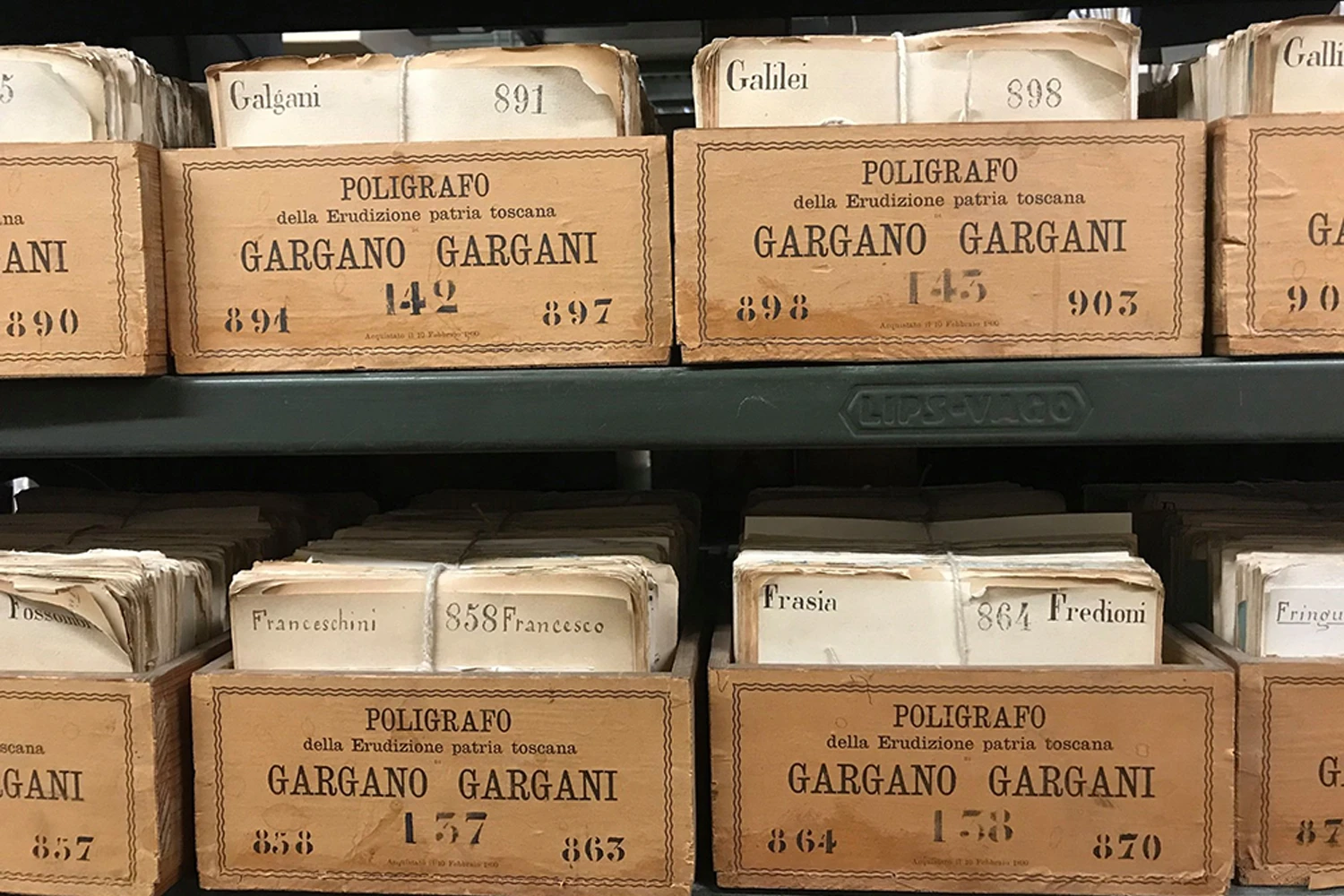
The results of these policies were positive: in that period, despite countless economic difficulties, there was a consistent increase in the collections. The library received dozens of items of contemporary correspondence, there was an increase in the collections of oriental and Galilean manuscripts; didactic materials were acquired that continue to be used today, such as the Poligrafo Gargani historical index, and famous library collections (Rossi-Cassigoli, Miscellanea Capretta, etc.) were gained, as well as lesser-known collections (three thousand historical works previously belonging to Pompeo Litta).
Chilovi also made extensive use of exchanges, focusing his efforts on the “Bulletin”. The possibility of using the “Bulletin” to implement a systemic exchange system, in addition to his extensive contacts with the international library system, was undoubtedly a source of significant results, allowing him, among other things, to also set up new collections, such as that of university theses from Germany, France, Sweden and Norway.
Another significant problem that Chilovi found himself tackling when his assumed the directorship of the BncF was that of standardising the various catalogues by author, which had stratified over time. While maintaining that a library should have only one alphabetical catalogue, in practice Chilovi embraced another solution, which was the setting up of a new catalogue. The new card-based alphabetical catalogue was not in any case the only one to be set up, and this period also saw the implementation of a catalogue of modern printed music, and probably that of maps. Other special catalogues that have been shown to exist in this period, but which have since disappeared, were related to certain sections of groups, such as, for example, legal briefs and book catalogues (DEL BONO, 1996 and 2000).
Bibliography
- Del Bono 1996
Gianna Del Bono, I cataloghi della Biblioteca nazionale di Firenze, «Culture del testo», II, 1996, 6, pp. 27-41. - Del Bono 2001
G.Gianna Del Bono, Per una storia della Bibliografia nazionale italiana. Desiderio Chilovi e i primi quindici anni di vita del “Bollettino” (Parte Prima), «Culture del testo e del documento», 2001, settembre-dicembre, p. 5-82. - Del Bono 2002
Gianna Del Bono, La biblioteca professionale di Desiderio Chilovi. Bibliografia e biblioteconomia nella seconda metà dell’Ottocento, Manziana, Vecchiarelli, 2002. - Del Bono 2003
Gianna Del Bono, Desiderio Chilovi, «Accademie e biblioteche», n.s., gennaio-giugno 2003, pp. 3-32. - Del Bono 2005
Gianna del Bono, Introduzione a Desiderio Chilovi, Scritti scelti editi ed inediti, a cura di Gianna Del Bono, Firenze, Le Lettere, 2005, p. VII-XCI. - Del Bono 2007¹
Gianna Del Bono, Desiderio Chilovi. Per una biografia professionale, in Il sapere della nazione. Desiderio Chilovi e le biblioteche pubbliche nel XIX secolo: atti del convegno, Trento, 10-11 novembre 2005, a cura di Luigi Blanco e Gianna Del Bono, Trento, Provincia autonoma di Trento, Soprintendenza per i beni librari e archivistici, 2007, p. 3-23. - Del Bono 2007²
Gianna Del Bono, Per la storia del sistema delle collocazioni nella BNCF, in Una mente colorata. Studi in onore di Attilio Mauro Caproni per i suoi 65 anni, promossi, raccolti e ordinati da Piero Innocenti, curati da Cristina Cavallario, Roma, Il libro e le letterature; Manziana, Vecchiarelli, 2007, pp. 997-1017.
