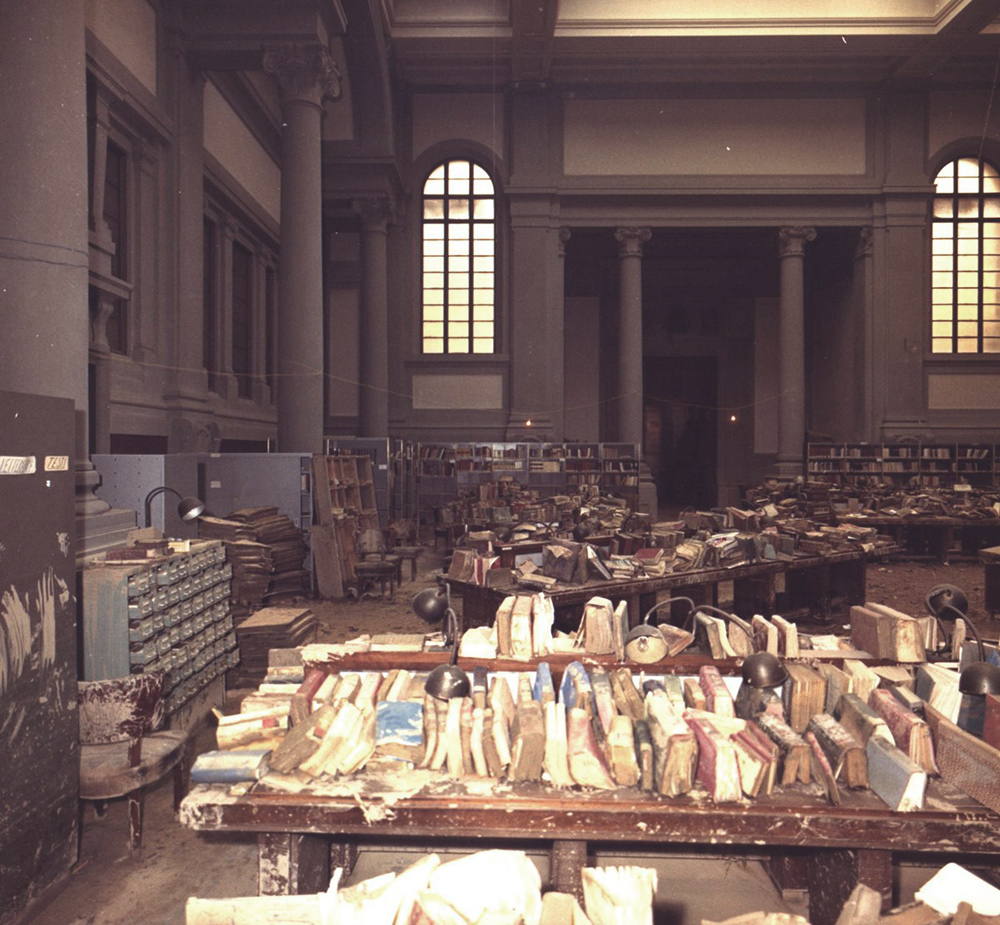
Constructed in the vicinity of the Arno, the National Library felt the full force of the flood on 4 November 1966, which submerged almost one million books stored in the basement, on the ground floor and on the mezzanine floor of the building.
Information on the history of the library has been sourced from the book: 1861/2011: l’Italia unita e la sua Biblioteca, Firenze, Polistampa, 2011 (Catalogue of the exhibition held in Florence in 2011-2012)
The damaged collections
Serious damage was caused to newspapers, foreign theses, periodicals and modern works, but above all to approximately one hundred thousand books from the Library’s historical collections, representing a large part of the Magliabechiana collection, the larger items from the Palatini collection and the precious Miscellanee collection. Equally serious damage was suffered by the catalogues and inventories, which were essential tools for library research, with an estimated six million catalogue cards suffering flood damage.
The extent of the disaster was such that it attracted both financial aid (thanks to CRIA and the IAARF) for Florence and support from technical experts from all over the world, including America, England, Germany, Austria, Australia and Czechoslovakia, as well as others. Of these figures, the commitment of restorers such as Peter Waters, Roger Powell, Don Etherington, Anthony Cains, Christopher Clarkson, Dorothy Cumpstey, Sandy Cockerell, Stella Patri, Richard Young and many others deserves mention. The sheer volume of the situation required the immediate setting up of a laboratory that was large enough to handle the problems facing the institute, which were threatening its very survival as the most important library in Italy.
The exceptional competence demonstrated by Emanuele Casamassima, the-then director of the library, in organising the necessary operations and identifying new and immediate solutions to the various problems, international aid and the hundreds of young volunteers – the “mud angels” – enabled the setting-up and organisation of a book restoration centre that, at least for a certain period of time, was the largest in the world. Over the course of just a few weeks after the flood, tons of books were extracted from the mud, transported to a safe location, dried and subjected to general cleaning. The laboratory was initially set up in the central heating plant of the railway station, which, together with the Forte di Belvedere – where the books were sent once they were dry – represented the initial base of the laboratory. The following spring the laboratory was moved to the library, initially precariously set up in the basement and only later moved to the new wing of the building.
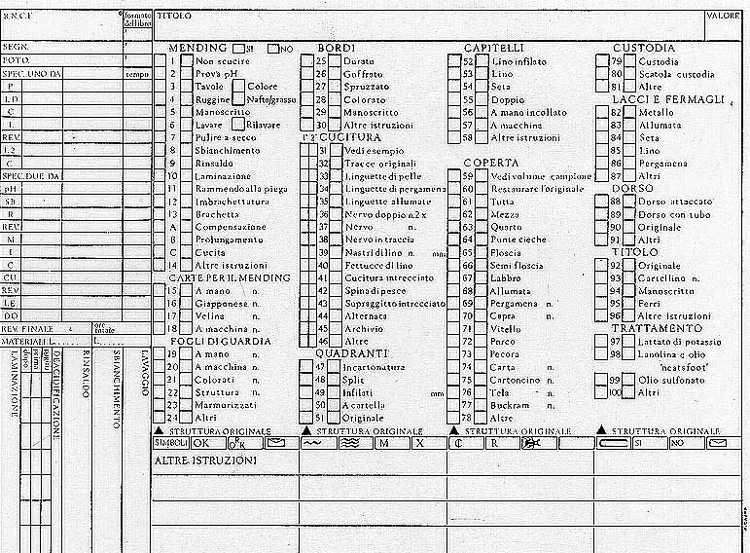
When it was first set up, the laboratory was organised like a huge assembly line (assessment, removal of stitching, wet operations, patching, stitching and binding), which handled book restoration in a manner that was both necessarily “industrial” and at the same time innovative. Every book was accompanied by a card that described both the damage suffered and the original structure, information that was used as a basis for the choice of a new cover in line with strictly functional standards. This marked the establishing of a new concept of book restoration, which until then was focused on the pseudo-philological reconstruction of each individual item.
The collections recovered
Over the years, a significant proportion of the written heritage damaged has been recovered and rendered once again available for consultation, but more than fifty years on from the disaster, there is still much to be done.
Summary of flood-damaged antique collections | April 2019
FONDO LIBRARIO
FLOOD-DAMAGED BOOKS
RESTORED
CLEANED
TO BE CLEANED
MISSING
OTHER**
Magliabechiana collection
59.816
34.908
13.852
1.333
4.062
5.194
Palatina collection
9.869
5.666
2.777
602
229
486
Palatina collection file
587
504
—
5
78
—
Shelved collections
1.012
339
229
311
139
—
Miscellaneous Magliabechiana items
42.012 *
11.781
21
?
n.q. *
—
SUBTOTAL
113.296
53.198
16.879
2.251+
4.508+
5.680
Note integrative ai dati:
* Ancient Miscellany (Miscellanee Antiche): The number of flood-damaged miscellanea cannot be exactly determined; the figure provided represents only the total number of items identified to date.
* Missing Miscellany: The number is currently unquantifiable (n.q.) as the identification of material lacking shelfmarks/location is still ongoing.
** Other: This category includes material in specific conditions, such as fine or noteworthy bindings, items transferred to different shelfmarks, or so-called “mattonati” volumes (fused/blocked together by mud and time).
Magliabechiana collection
52.583 flood-damaged books; 33,015 restored; 15,396 to be restored; 4,172 missing/unidentified
Palatina collection
9527 flood-damaged books; 6,003 restored; 3,242 to be restored; 282 missing/unidentified
Palatina collection file
587 flood-damaged records; 500 restored; 5 to be restored; 78 missing/unidentified
Miscellanee magliabechiane
42012 miscellaneous flood-damaged items (the number of miscellaneous antique flood-damaged items cannot be determined with precision, and therefore the number represents the total identified to date); 11,781 restored; 30,231 to be restored; — missing/unidentified (the number of miscellaneous items missing cannot be calculated as the identification of unclassified materials is still under way).
Florence and the flood
“I got to the library about 5 PM and I looked down into the flooded area. There was no electricity, and massive candles had been set up to provide the light necessary to salvage the books. It was terribly cold and yet I saw students up to their waists in water. They had formed a line to pass along the books so that they could be retrieved from the water and then handed on to a safer area where some form of protection could be applied. Everywhere I looked in the great main reading room were hundreds and hundreds of young people who had all gathered to help. It was if they knew that this flooding of the library was putting their soul at risk… I will never forget it”.
Edward M.Kennedy was one of the witnesses to the first-ever widely reported flood, which shocked and moved the world. On the night of 4 November 1966, the river Arno flooded Florence and other cities, leading to 39 deaths, inundating roads and squares, homes and cellars, parks, museums, libraries and churches. Muddy liquid flowed at shocking speed. It was a flood like none ever experienced before, caused by exceptional weather conditions and aggravated by the State’s equally exceptional inability to provide for and manage rescue operations.
And yet, as early as dawn on 3 November, Florentine military commanders had been making telephone calls and sending telephone reports in an attempt to alert ministries and commanding officers. It was all in vain. Rivers and streams overflowed, but at the time, Italy was defenceless and the Arno had not even been classified as a flood risk, even though it had inundated the city 180 times since 1177, 56 of which saw devastation. None of the local authorities had any inkling that this was the eve of a flood that would go down in history. However, amateur radio operators sent dramatic SOS messages from Montevarchi, Figline, Incisa, Rignano, Reggello and Pontassieve, where entire families had climbed onto the roofs of farmhouses and the Resco torrent had already hit houses, killing 7 people; it was a situation of total desolation and isolation. Both the A1 motorway and railway line were under water.
Rome continued to underestimate the situation, but at midnight the Arno swept away the legendary Anchetta suspended bridge at Sieci as though it were a twig, and in the darkness, the river flowed within arms’ reach of the parapets that bordered it. What was to be done? The prevailing thought was to wait it out. Raising the alarm would have led to a mass exodus of residents and tourists, either by bus, car or on foot, with the risk of them being trapped by the rising waters. In the end, this prudence – better defined as a complete lack of planning -, combined with the fact that 4 November was a national holiday, saved many lives. However, one-metre-high jets of water burst from the sewers of Piazza Mentana. At 2 a.m., the banks of the Mugnone broke, flooding the farm buildings and killing 70 thoroughbreds at the racecourse as well as all the animals in the zoo. Half an hour later, the Arno had inundated Varlungo and San Salvi, and then the entire Gavinana area, which would remain isolated for three days. The river flooded Santa Croce and San Niccolò, Brozzi and San Donnino, Santo Spirito and San Frediano, as well as the new districts of Isolotto and San Bartolo a Cintoia. It was a night of pure terror.
At 7.26 a.m. the electrical clocks stopped, and the main doors of the National Library burst open under the force of the water. Florence was cut off from the world by a frenzied river swollen with tree trunks, bins, the bodies of animals, cars, mopeds, traffic lights and benches. The barracks were flooded, the hospitals were at breaking point, and the waters were rising at a tremendous speed. At 11 a.m., the BBC announced the dramatic news from London: “The world is about to lose one of its most precious treasures: Florence”. Television networks in the United States also broadcast images taken from a helicopter that had taken off from Camp Darby. Italy was unaware of the inestimable damage suffered. All of the public services in the city were out of use, from telephones to mains gas and water. 6,000 shops were destroyed, more than 70,000 families were left homeless, 20,000 cars were immersed in the water and mud, and thousands of workshops, factories, laboratories and stores were flooded. As the new day dawned, the mayor Bargellini made an appeal to the world from Palazzo Vecchio, while in the cenaculum of Santa Croce, sludge and oil attacked the crucifix by Cimabue, which became a universal symbol of the tragedy.
Sensing the mounting anger, the president of the Republic Giuseppe Saragat reached Florence before rescue teams, and toured the devastated city in a Jeep. He was greeted with boos from the outraged flood victims. At the National Library, the director Emanuele Casamassima expressed his anger, shouting: “President, let us get on with our work”. The protests speeded up rescue efforts. However, the National Library represented the nucleus of a sense of solidarity, with a race against time to save one million three-hundred thousand antique books, collections of geographic and topographic maps, newspapers and manifestos, miscellaneous items and modern works. Long human chains were formed, working day and night. Over the course of those hours, thousands of young people set off from all over Italy and from countries around the world to take part in the greatest rescue operation of historic heritage ever seen.
They came to the city bit by bit, alone or in groups, all of their own accord, with backpacks and cars filled to the brim with whatever they needed to be self-sufficient, with coaches organised by schools and countless municipalities, and then with military convoys. They spoke regional dialects, English, French, Spanish, German and Arabic. They had the long hair and beards of protesters, and they brought guitars and shovels, medicines and provisions. They worked in the waters, in the stench of oil and sewage, risking epidemic and infection, and they were successful. There were those who looked on them with an air of mistrust, and – in the eyes of zealot Italy – they were nothing more than “hippies”. It was the author and journalist Giuseppe Grazzini who explained to the world that these people were angels, the mud angels.
The flood in the library
After every war/ someone has to clean up (…) Someone has to push the rubble/ to the side of the road,/ so the corpse-filled wagons/ can pass (…) Someone has to drag in a girder/ to prop up a wall./ Someone has to glaze a window, rehang a door./ Photogenic it’s not,/ and takes years./ All the cameras have left/ for another war (…)/ Those who knew/ what was going on here/ must make way for/ those who know little./ And less than little… Wislawa Szymborska , The end and the beginning
Since 22 December 1861, when the library of the people of Florence became a National Library, and, adorned with tricolour rosettes and flags, regained its Italian nature, much water has flowed under the bridges, as well as, in 1966, over them, with that river that has always bordered it and, as Galileo would have said, “… with its innate unevenness, it adapts and fills the hidden cavities” (Galilei 1718). It is almost as though the library and the river represented the two sides of the Moon, with the former hidden and the latter clearly evident and much more celebrated. There is no doubt that the library, new in terms of the building but with much history behind it, clearly remembers the morning of 4 November 1966, when its neighbour lost all restraint, almost as though it wanted, perhaps for one, unforgettable moment, to become the largest river in the world, bursting open the sewers, breaking into shops, filling homes and destroying treasures, with the loss of many lives. It deprived the library of light and heat, but worst of all it caused profound harm, attacking its precious books, soiling, scorning and ruining them, spreading destruction and desolation of a type usually reserved for very different settings. It was almost as though we had returned to the times of war and of the Resistance, with, as it was then, the horror of disaster and the relentless passion of an army of young “degenerates” (the mud angels), with their uncommon spirit, clothes and language, led with grace, determination and charisma by the Commander “Nello” Emanuele Casamassima, the library director, who ordered the arming of the ship and who watched over it, without leaving for a single day in three months, sleeping there, at the helm, in a sleeping bag, with the sole companionship on alternating days of Alfiero Manetti, Giorgio de Gregori, Francesco Barberi and a bottle of grappa. He was accompanied by his crew: the taciturn Vice-commander (Luigi Crocetti), the Chief Engineer (Ivaldo Baglioni) brusque and generous, with a booming voice, the Boatswain (Alfiero Manetti) who supervised the crew, the doctor (Claudio Galanti) charged with vaccinations, and the petty officers (Renzo Romanelli, Diego Maltese, Eugenia Levi, Fulvia Farfara, Carla Guiducci Bonanni, Clementina Rotondi) who unhesitatingly left their desks to reconstruct collections and rebuild services. It was the same ease with which Alberto Cotogni, Renzo Daddi and Omero Bardazzi took on the roles of cooks and sandwich-makers to feed the angels, or with which the ship’s hands Fornaciai, Bertini and Corradi handled the trucks that took the books off to the ovens for drying, as well as the many others who, perhaps without understanding the gravity of the task, made their own contribution to salvaging the National Library. It was, in all, an early “yes we can” (a real one on this occasion) embraced by the Library in beginning the slow and painful recovery from its many, deep wounds. Faced with desolation and defeat – ours, at the hands of what had become the evil face of the Moon – Commander “Nello” never gave in: he gathered some of the best minds and formed a committee, setting sail with his young and improvised crew. They worked without rest and faced all kinds of struggle, seeking out funds and assistance, which they found almost everywhere: from England, America, France, Australia, Czechoslovakia… and also Italy, although at times a little naive and superficial (some, for example, were convinced that sawdust and talcum powder could be used to dry pages, while others, seeking to dry the books threatened by the imminent attack of mould, sought out ovens of varying size, without too much hesitancy, leading to burned leather, damaged parchment and warped pages). In March 1967, the Manuscript and Renaissance halls reopened, the BNI recommenced publication and, immediately after, the Captain and Vice-commander, with their English second-in-command directors Peter Walters and Tony Cains, set up a restoration laboratory of a greatness that matched the gravity of the damage suffered, while the Boatswain gathered the “workforce”: volunteers paid by CRIA (the Committee to Rescue Italian Art), as well as foreign technicians and others appointed by the LAT cooperative, who were paid with State funds. The director and the treasurer, Alfonso Bonanni, even risked accusations of misappropriation of funds, with as many as three inspections by the ministry, because they were using resources allocated to the library for administration (stationery, electricity, photocopies) to buy sandwiches for the young workers and get them vaccinated. At the same time, in order to get this “darned library” open again, they were also working on other fronts: they cleaned and copied catalogue cards, which represented the inventory, they arranged furniture and fittings, they substituted the shelving and, wherever possible, replaced lost books through donations from other institutions. What times, what chaos… and such vitality! Finally, on 8 January 1968, “Nello” took off his Commander’s uniform, put on his Director’s spectacles, and after an extremely brief review of the work done and the work still do be done, reopened the library, thus, in a certain manner, marking the division between the heroic times (yes, heroic, even though the term may be seen as rhetorical, for the idealism and the spirit of solidarity that had been demonstrated) and the dark and extremely bitter period that was to come.
The catastrophe and anastrophe of the Newspaper collection
by Sergio Marchini
To Luciano, a brother, more than a friend, and to Beppe, my mentor, you live on every day in the garden of my heart
The newspapers were stored in the basement (EDIFICIO 1986) and, at dawn on 4 November 1966, were completely submerged by the waters of the Arno and damaged by the river’s current, which was extremely strong at the corner between Corso Tintori and Via Magliabechi (DI RENZO 2009). In the days that followed, it seemed as though the entire collection had been lost. As Pierfrancesco Listri wrote in “La Nazione” : “Another grave loss is that of the Newspaper collection. All the collections of the newspapers published in Italy ever since the Unification, consigned to us by legal deposit, allowing us to serve as the only true and complete archive of periodical collections, lie submerged in the mud and water, and may have been lost…” (LISTRI 1966). I will not linger too long on all those who hurried to help the library, on the determination to save its heritage, under the tireless and unwavering guidance of Emanuele Casamassima, who organised and coordinated the colossal task of recovering everything that had been damaged, with the involvement of employees, Italian and foreign technicians, and thousands of young volunteers, myself among them. In the dim light of the basement, in short yet intense shifts, everything that had been submerged was brought onto dry land, often by brute force alone. The newspapers were sent in parcels, bags and volumes dripping with muddy water and oil to every drying facility available in Italy and, with the efforts of all the staff, were dried. In the summer of 1967, this enormous mass of material – the full collection contained, at the time, approximately 37,000 publications, of which between 24,000 and 27,000 were affected by the flood – began to return to the library. A commission composed of the Director, Clementina Rotondi, the newspaper supervisor, Giuseppe Bertini, a custodian of the newspapers and a fundamental expert on the collection, and Luciano Matteoli Giachetti, the representative of the students – a definition that covered all those who, following their period as volunteers, continued to work part-time in the library as members and employees of the LAT Cooperative, the majority of whom were university students aged on average between 22 and 24 – drew up the protocol for the restoration of the collection: the newspapers were to be divided alphabetically by the first letter of the headline, then the second letter, and lastly by publication name. Each publication was sorted by year, recorded and described, issued by issue, on new catalogue cards, with indications of damage and losses. As the material gradually returned to the library, unloaded at the entrance in Via Magliabechi, it was divided by the first letter in the corridors and then positioned on temporary shelving. Two whole books of maps were needed to find the way among the packed shelving units that were located on every floor of the library building. Initially, the recovery operation was slow and complicated: staff divided and sorted the publications surrounded by thousands of plastic bags, with the dust from the pages and the dried mud. The work was carried out in close collaboration with the university, particularly because many theses and research projects had ground to a halt due to the inability to access periodicals, and wherever possible, the indications of Ernesto Ragionieri, Giorgio Mori, Mazzino Fossi, Carlo Cordiè and Giuliano Procacci, all professors at Florence University, led to the selection of publications to be prioritised. The operation allowed for the recovery of all the Italian newspapers from 1872 onwards, the periodicals from Tuscany and beyond from before Italian Unification, as well as weekly, fortnightly, monthly and occasional publications that were extremely important, impossible to find elsewhere, and essential for research and study. The new catalogue cards also allowed for descriptions of publications preceding 1872, the year in which records began, an aspect later extended to the entire collection which had, between 1872 and 1966, changed form, classification criteria and management various times. We now know that 8-10% of all the publications in the collection were lost, as well as various issues of those recovered, which have not been altogether quantified. The newspapers have been organised and registered, but not restored: only the periodicals dating from the second half of the 1700s to 1861, as well as a number of Florentine publications, 300 in total, have been restored and recorded on microfilm; the rest is still to be done. Classification was completed as a result of two projects funded by the Ministry of Cultural Heritage and Activities, and since 1999, users have had access to the entire collection, save for two publications, the “Corriere Mercantile” and the “Osservatore Romano”, which are, however, recorded on microfilm. The newspapers cover a total of more than 10,000 metres of shelving, and have been stored in the barrack warehouses of the Forte di Belvedere since 1989. The fact that the collection is available for consultation is due to the will and the efforts of all those who, since 1967, have persevered in an operation that seemed impossible.
Bibliography
Di Renzo 2009 Elisa Di Renzo, Una biblioteca, un’alluvione: il 4 novembre 1966 alla Nazionale di Firenze, storia di un’emergenza; introduzione di Neil Harris, Roma, Associazione italiana biblioteche, 2009.
Edificio 1986 L’Edificio della Biblioteca nazionale centrale di Firenze, Firenze, Forte di Belvedere, ottobre –novembre 1986, Firenze, Karta, 1986.
Listri 1966 Listri, Pierfrancesco, Milioni di libri sotto il fango, « La Nazione, Firenze », CVIII, 1966, n. 253, 9 novembre, p. 3.
Emanuele Casamassima
He was the tallest (and perhaps the most handsome) man at the library, but on the morning of 6 November 1966, when we managed to get into the building, all of a sudden, as I glimpsed him in the midst of the foul-smelling rubble, he seemed even more impressive, with his ever-present brown velvet jacket and his rubber boots, as he unhesitantly gave orders to the mass of people swarming around him. Even in “normal times”, I had had the fortune of working with Emanuele Casamassima, who always had the answer to whatever problem may emerge, but that was of course a normal thing for a librarian. That morning, the director was already “saving” the National Library with the same clarity, simplicity and decisiveness that he always applied to his work; alongside him was Giorgio De Gregori, who had rushed from Rome to the National Library, also to help his lifelong friend with his precious presence and practicality. Nothing was done casually, nothing was to harm the library’s collections in any way, which is why all the help that came to the library from Italy and abroad, including the generous presence of many professors, in particular from the university of Florence, were kindly yet firmly directed by Casamassima to wherever they would be able to help in the immediate salvage of the flood-damaged materials. I recall the bitter fight, which even reached the press, over the theories for immediate conservation. He received much criticism over his choice to send the books extracted from the sludge to all the available drying facilities and ovens to be dried. At the time, many maintained that paper should be kept wet, as it was when recovered, and stored in that condition until it could be restored. Once again, Casamassima was proved right: the heritage of the National Library has been fully restored, while books treated in a different manner have, unfortunately, suffered from severe microbiological problems that have complicated their recovery. Another important lesson that Casamassima taught us all was made clear when, faced with the disaster of 4 November, the people he appointed to supervise staff, volunteers and equipment were the ones he considered actually capable of concrete action, irrespective of their institutional role or standing. As can be imagined, this decision was extremely unpopular with the authorities appointed by the Ministry, as well as a few inflexible “colleagues”, but the majority of us responded without hesitation to those that Casamassima had chosen, with the sole aim of salvaging and rebuilding the National Library. As a result, just two years later, the library reopened to the public, albeit with all the necessary limitations; publication of the National Bibliography also recommenced, as did the cataloguing of new material. Emanuele Casamassima, who was director of the library from 1965 to 1970, during a tour of the restoration laboratory He was also responsible for setting up the restoration laboratory, and we can now proudly claim that the disastrous flood also led to the emergence of a new, practical salvaging technique that is much more effective and preservative than methods used until then. On the subject of restoration, one particularly “curious” episode comes to mind. Casamassima sent me and Renzo Daddi to receive the dried materials being returned and to, at least generally, reorganise them. One day, on one of his many visits to Forte Belvedere, the director arrived while we, together with a group of volunteers, carefully removed damaged covers from the dried books without any intention of keeping the latter, throwing them onto a pile; with a smile, he praised our idea of removing the cover from the book… and conserving it with the relative coding for the complete recovery of the work. I still remember the “interrupted” flight of the cover I was holding at the time, as well as the petrified expressions of all those present, who immediately began to treat the covers in the same way they were treating the books, while at the same time trying to recover as much as possible from the pile of material that had already formed. This was part of how the restoration efforts were born, calmly explaining that every part of a book being handled has its own story and plays an essential role. On my return from Forte Belvedere, Casamassima assigned me to the restoration laboratory, perhaps recalling my old degree in mathematics and physics, but undoubtedly knowing that he could count on my unwavering trust in his work. In hindsight, that marked a fundamental milestone in terms of my work in the library. My professional and personal contact with the restoration workers taught me much, overcoming the “operational abstraction” that sometimes emerges with other sectors of the library. These accounts, based on my personal experience, are by no means isolated events; all those working at the National Library have grown and “transformed” under the intelligent, kind and expert guidance of Emanuele Casamassima. This is what makes the figure of this director so essential for the National Library; there is no doubt that without him, we would never have recovered the activities or the services of the library, nor would we have seen the training of an entire generation of librarians.
...Turning over a new leaf: how restoration changed in the wake of the flood
From our point of view here in the present, the manner in which the library director and staff handled the flood – an unprecedented disaster in terms of both the quantity and condition of the materials – appears obvious and almost unworthy of note. Yet, as Virgil said to Dante, they could claim “Ye suppose perchance / Us well acquainted with this place: but here, / We, as yourselves, are strangers”, and the mistakes that were made, due to improvisation and haste, were insignificant in comparison to the idea of focusing the efforts on getting the books dry.
The restoration laboratory was set up in the wake of this daunting task, driven by the will to save thousands of books, all on the basis of rules that differed greatly from those of the past, which saw restoration concerned with binding (BIBLIOTECA NAZIONALE 1881). In the wake of the flood, the concept of restoration at the library was based on a practice that, despite the immense pressure placed by the emergency, which made it extremely difficult to simply gather one’s thoughts, nothing was left to chance, and strict protocols for action were set up, organising the salvaging of books on the basis of rapidity, efficient results and maintaining historical coherence in planning new bindings, focusing on models that were free of stylistic pretence and based on functionality (CASAMASSIMA 1957), while at the same time not completely breaking from tradition, maintaining aspects of the books, their dimensions and their belonging to a particular collection. Even the five categories on the basis of which the books were generally divided – in terms of their year of printing, allowing the new binding to be established in a rapid and precise manner – were perfectly in line with these founding principles. All the flood-damaged books were photographed, and each was assigned a descriptive-prescriptive restoration sheet with an analytical layout that defined the process and that, once archived, served both as a record of the appearance of the book and a verification of the stability of the materials and methods used for restoration. A philological system was also introduced to monitor the integrity of the text; innovative adhesives such as starch and methylcellulose were used to repair and glue, calcium hydroxide was used to de-acidify paper, and washi was employed to patch pages and as a way to “quickly” reattach torn double leaves. At the same time, it was considered essential to use compatible techniques and products that were of the best quality and reversible, suited to the demands of what was later to be defined as mass-restoration.
The Florentine experience thus marked a break from “artisan” book restoration and the embracing of modern restoration. In the first case, the main goal was to remove stains from pages or rebind a broken volume, considering the book in a common and reductive manner and not as a work of art, while in the second case, all books are seen as an entity made up of a series of components, none of which can be restored alone without taking all the others into consideration (CROCETTI 1974), and all of which need to be conserved in the best possible manner, without any sense of hierarchy. Even books requiring restoration that appeared insignificant or visually unattractive were to be treated as unique (CROCETTI-CAINS 1970), in other words as an irreplaceable expression of its own particular history. These “revolutionary” axioms, which were by nature hard to accept or to put into practice, were further complicated in terms of the flood by the huge number of books affected, a factor that could have led to superficial and improvised actions justified by the state of emergency. Instead, the need to unstitch and detach the cover boards of thousands of books was welcomed as a fantastic opportunity to explore the material components of the books, how they were combined and interlaced, through a philological study that separated the original from any additions without, however, eliminating the latter.
The Florentine restoration project marked an unexpected shift from inevitably destructive operations to non-invasive methods, while at the same time going as far as to embrace the prevention of damage caused by poor maintenance and emergencies, with risk plans playing an essential role. Then there were the limitations of this experience, first and foremost the division of the restoration operations resulting from an industrial-type organisation of efforts into distinct sectors, which was necessary in order to be able to handle the vastness of the project but which also meant that, for a lengthy period of time, the left hand had no idea what the right was doing; as a result, the reconstruction of the finished object, the result of the efforts of many, was the knowledge of only a few. Then there was the silent yet constant crumbling of the ideological drive behind the Florentine restoration centre, which, having over time been worn down by ministerial red tape and the effects of political ideas that were not always sensitive or far-sighted, is still awaiting better times and more appropriate resources in order to be able to achieve its founding goals.
Bibliography
Biblioteca Nazionale Firenze 1881 Regolamento per il servizio della Biblioteca nazionale di Firenze (Minuta), Firenze, agosto 1881.
Casamassima 1957 Emanuele Casamassima, Nota sul restauro delle legature, «Bollettino AIB», III, 1957, n. 1-2, p. 2.
Crocetti 1974 Luigi Crocetti, Il restauro del libro come attività normale, «Antologia Vieusseux», IX, 1974, n. 3, p.7.
Crocetti – Cains 1970 Luigi Crocetti – Anthony Cains, Un’esperienza di cooperazione, «Bollettino dell’Istituto di patologia del libro», XXIX, 1970, n. 1, p. 48.